09 March 2026
How to Plant Maize for High Yields in Kenya: A Step-by-Step Guide for Farmers
Maize is one of the most widely grown crops in Kenya and plays a major role in food security and farmer livelihoods. However, many farmers struggle with low yields due to poor planting practices, improper fertilizer use, and inadequate soil preparation.
The truth is that successful maize farming starts with proper planting techniques. When maize is planted correctly and supported with the right nutrients, farmers can significantly increase their yields.
In this guide, we explain how to plant maize for high yields in Kenya, including land preparation, spacing, fertilizer application, and early crop management.
1. Prepare the Land Properly
Good maize production begins with proper land preparation.
Before planting, the field should be cleared of weeds and crop residues. The soil should then be ploughed and harrowed to create a fine seedbed.
Proper land preparation helps improve:
-
Soil aeration
-
Root penetration
-
Water infiltration
-
Seed-to-soil contact
A well-prepared seedbed allows maize seeds to germinate easily and develop strong root systems.
Farmers can also improve soil conditions by using soil amendments such as agricultural gypsum to improve soil structure. You can learn more about this in our guide:
https://seedpro.co.ke/what-is-agricultural-gypsum-a-complete-guide-for-farmers/
2. Choose High Quality Maize Seeds
Selecting quality seeds is another important step in maize production.
Farmers should choose certified maize seeds that are suitable for their region. Certified seeds are tested for quality and often have higher germination rates.
According to the Kenya Agricultural and Livestock Research Organization, improved maize varieties can significantly increase productivity when combined with proper agronomic practices.
Healthy seeds give crops a strong start and improve the chances of achieving good yields.
3. Plant at the Right Time
Timing is very important when planting maize.
Farmers should plant at the beginning of the rainy season to ensure crops receive enough moisture during the early growth stages.
Early planting helps maize crops establish quickly and reduces the risk of moisture stress later in the season.
Delayed planting often results in poor crop development and reduced yields.
4. Use the Correct Maize Spacing
Proper spacing allows maize plants to access enough sunlight, water, and nutrients.
Recommended maize spacing for most varieties in Kenya is:
-
75 cm between rows
-
25–30 cm between plants
Farmers usually plant one or two seeds per hole depending on the seed variety.
Proper spacing improves airflow within the crop and reduces competition for nutrients.
5. Apply Fertilizer at Planting
One of the most important steps in maize farming is applying fertilizer during planting.
Young maize plants require sufficient nutrients, especially phosphorus, to support early root development and crop establishment.
Fertilizers used during planting should contain nutrients that promote strong root growth and early plant vigor.
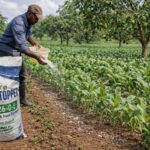
Organo-mineral fertilizers such as DAP Plus are commonly used at planting because they supply essential nutrients while also supporting soil health.
Phosphorus plays an important role in plant growth. According to the Food and Agriculture Organization, phosphorus supports root development and energy transfer within plants, making it essential during early crop growth.
6. Apply Fertilizer Correctly
Proper fertilizer placement is essential for effective nutrient uptake.
Farmers should avoid placing fertilizer directly on the seed because it may damage the seed.
Instead, fertilizer should be placed slightly beside or below the seed during planting.
Correct fertilizer placement ensures young maize plants can access nutrients without risking seed damage.
7. Control Weeds Early
Weeds compete with maize crops for nutrients, water, and sunlight.
If weeds are not controlled early, they can significantly reduce maize yields.
Farmers should remove weeds early during the crop’s growth stages, especially within the first three to four weeks after planting.
Early weed control helps maize plants establish properly and grow vigorously.
8. Monitor Early Crop Growth
The first few weeks after planting are critical for maize development.
Farmers should monitor their fields regularly to check for:
-
Poor germination
-
Pest damage
-
Nutrient deficiencies
-
Weed growth
Addressing problems early helps prevent major yield losses later in the season.
Healthy crops during the early stages usually lead to better productivity at harvest.
9. Support Soil Health for Long-Term Productivity
Healthy soil plays a major role in successful maize production.
Farmers should focus on practices that improve soil fertility, including:
-
Using balanced fertilizers
-
Adding organic matter to the soil
-
Practicing crop rotation
-
Using soil conditioners where necessary
Improving soil health ensures that crops receive nutrients efficiently and helps maintain productivity over many seasons.
Final Thoughts
Planting maize successfully requires more than just putting seeds in the ground.
Farmers who want higher yields must focus on proper land preparation, quality seeds, correct spacing, and balanced fertilizer application.
Providing maize crops with the right nutrients during planting is especially important because it supports strong root development and healthy early growth.
When farmers combine good planting practices with proper soil management, they can significantly improve crop performance and achieve better harvests.