 06 March 2026
What Is Agricultural Gypsum? A Complete Guide for Farmers
Introduction
Healthy soil is the foundation of productive farming. Yet many farmers focus heavily on fertilizers and overlook one important soil improvement material known as agricultural gypsum.
Agricultural gypsum, often referred to as agri gypsum or calcium sulphate, is one of the most effective soil conditioners used in modern agriculture. It helps improve soil structure, increase water infiltration, and supply essential nutrients such as calcium and sulphur to crops.
Many farmers in Kenya are now discovering the benefits of gypsum in improving soil health and increasing yields. However, there is still confusion about what gypsum actually is, how it works, and the difference between normal gypsum and agricultural gypsum.
In this guide we explain everything farmers need to know about gypsum and why it is becoming an essential soil amendment in crop production.
What Is Gypsum?
Gypsum is a naturally occurring mineral made of calcium sulphate dihydrate (CaSO₄·2H₂O).
It contains two very important plant nutrients:
• Calcium (Ca)
• Sulphur (S)
These nutrients play a key role in plant growth and soil health.
Unlike lime, gypsum does not significantly change soil pH. Instead, it improves soil structure and nutrient availability without making the soil too alkaline.
Because of this unique property, gypsum is widely used in agriculture as a soil conditioner rather than just a fertilizer.
What Is Agricultural Gypsum?
Agricultural gypsum is gypsum that has been processed and refined specifically for farming use.
This type of gypsum is specially prepared to ensure:
• High purity
• Safe application in soil
• Proper particle size for quick soil absorption
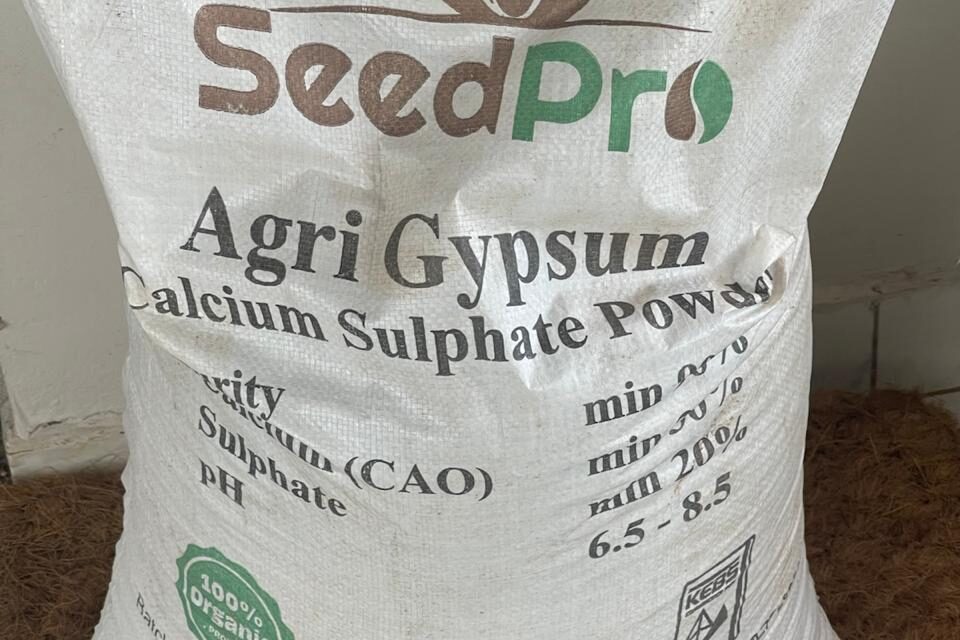
Products like SeedPro Agri Gypsum are manufactured for agricultural use to help farmers improve soil health and crop performance.
Agricultural gypsum is commonly used in:
• Vegetable farming
• Coffee farming
• Maize production
• Fruit farming
• Horticulture crops
It works by improving soil conditions so that plants can access nutrients more easily.
Difference Between Normal Gypsum and Agricultural Gypsum
One of the biggest mistakes farmers make is assuming that all gypsum is the same.
In reality there are major differences between construction gypsum and agricultural gypsum.
1. Purpose
Construction Gypsum
Used in cement, plaster, drywall, and building materials.
Agricultural Gypsum
Used in farming to improve soil structure and provide plant nutrients.
2. Purity Level
Agricultural gypsum is processed to maintain high purity and safe levels for soil application, while industrial gypsum may contain impurities that are not suitable for crops.
3. Particle Size
Agricultural gypsum is ground into fine powder so that it dissolves quickly in soil and becomes available to plants.
This allows faster improvement of soil structure.
4. Nutrient Availability
Agri gypsum is optimized to deliver calcium and sulphur directly to the root zone, making it more beneficial for crop production.
Why Farmers Use Agricultural Gypsum
Gypsum provides multiple benefits to the soil and crops.
1. Improves Soil Structure
One of the biggest advantages of gypsum is its ability to break up compacted soil.
In clay soils, particles tend to stick together, which reduces air movement and water infiltration. Gypsum helps separate these particles, improving soil structure.
This leads to:
• Better root growth
• Improved aeration
• Increased microbial activity
2. Supplies Calcium to Crops
Calcium plays an essential role in plant development.
It strengthens plant cell walls and helps prevent physiological disorders such as:
• Blossom end rot in tomatoes
• Bitter pit in apples
• Tip burn in vegetables
Gypsum provides calcium in a form that plants can easily absorb.
3. Provides Sulphur for Crop Growth
Sulphur is another critical nutrient required by plants for:
• Protein formation
• Chlorophyll production
• Improved crop quality
Many soils in Kenya are becoming deficient in sulphur due to continuous farming. Gypsum helps replenish this important nutrient.
4. Improves Water Infiltration
When soil becomes compacted, water cannot penetrate easily.
Gypsum improves the soil structure so that rainwater and irrigation water can move deeper into the soil profile. This helps reduce runoff and improves water efficiency.
5. Reduces Soil Crusting
After heavy rain or irrigation, some soils develop a hard crust on the surface.
This crust makes it difficult for seedlings to emerge.
Gypsum helps prevent this by improving soil texture and reducing surface sealing.
When Should Farmers Apply Gypsum?
Gypsum can be applied during several stages of farming.
Common application times include:
• Before planting
• During land preparation
• When improving soil structure
• During crop establishment
For best results, gypsum should be incorporated into the soil during land preparation so that it reaches the root zone.
Crops That Benefit From Agricultural Gypsum
Many crops respond positively to gypsum application.
These include:
• Tomatoes
• Onions
• Capsicum
• Coffee
• Maize
• Beans
• Potatoes
• Fruits
Vegetable crops especially benefit from calcium supplied by gypsum because it improves fruit quality and shelf life.
Agricultural Gypsum as a Soil Conditioner
Soil conditioners are materials added to soil to improve its physical properties.
Gypsum is one of the most effective soil conditioners because it:
• Improves soil structure
• Enhances root development
• Promotes better nutrient uptake
• Supports healthy microbial activity
This makes it an essential component of sustainable farming.
Farmers looking to improve soil fertility often combine gypsum with fertilizers and organic manure for maximum results.
You can also learn more about improving soil nutrition in our guide:
https://seedpro.co.ke/how-to-identify-nutrient-deficiencies-in-crops-before-its-too-late/
Why Soil Health Matters for Farmers
Over time, continuous farming depletes soil nutrients and weakens soil structure.
Without proper soil management, crops struggle to access water and nutrients.
Using soil conditioners such as agricultural gypsum helps restore soil health and ensures long term productivity.
Healthy soil means:
• Stronger crops
• Higher yields
• Better crop quality
Conclusion
Agricultural gypsum is an essential soil amendment that improves soil structure, provides calcium and sulphur, and enhances crop productivity.
Unlike construction gypsum, agri gypsum is specially prepared for farming, making it safe and effective for agricultural use.
Farmers who invest in soil health by using gypsum often experience improved root growth, better water infiltration, and healthier crops.
If you are looking to improve your soil conditions and boost crop yields, agricultural gypsum can be a valuable addition to your farm management practices.
To learn more about soil improvement and crop nutrition, explore more resources on SeedPro Kenya.