 06 October 2026
Foliar Fertilizers in Kenya: Complete Guide to Choosing and Applying Foliar Fertilizer
What Are Foliar Fertilizers?
Foliar fertilizers are fertilizers applied directly to the leaves of a crop through spraying. Unlike fertilizers applied to the soil, foliar fertilizers provide nutrients through the leaves, making them useful when a crop needs quick nutritional support or when certain nutrients are not readily available from the soil.
Farmers growing vegetables, maize, tomatoes, onions, fruits and other crops can use foliar fertilizers at different stages of crop growth depending on the nutritional needs of the crop.
Foliar feeding does not necessarily replace soil fertilization. Instead, it can complement a good crop nutrition program by supplying nutrients when the crop needs them most.
Why Are Foliar Fertilizers Important?
Crops require different nutrients throughout their growing cycle. Nitrogen supports vegetative growth and the development of green leaves, phosphorus is important for root development and energy transfer, while potassium plays an important role in water regulation, crop quality and overall plant strength.
Crops also require secondary nutrients and micronutrients such as calcium, magnesium, sulphur, zinc, boron, iron and manganese.
Sometimes a crop may show signs of nutrient deficiency even when fertilizer has already been applied to the soil. This can happen because of soil pH, moisture conditions, nutrient interactions, root problems or other factors affecting nutrient availability.
This is where foliar feeding can be useful.
Applying nutrients through the leaves can provide an additional route for nutrient uptake and can help farmers respond to specific crop requirements.
When Should You Apply Foliar Fertilizers?
The right time to apply foliar fertilizer depends on the crop, its growth stage and the formulation being used.
For vegetables such as sukuma wiki, spinach and cabbage, foliar feeding may be useful during active vegetative growth when the crop is producing new leaves.
For flowering and fruiting crops such as tomatoes, capsicum and other vegetables, the nutritional requirements change as the crop moves from vegetative growth into flowering and fruit development.
This means farmers should not simply use the same foliar fertilizer throughout the entire crop cycle.
The fertilizer should match the crop’s stage and nutritional requirement.
It is also important to follow the recommended application rate on the product label. Using more fertilizer than recommended does not necessarily produce better results and may cause leaf damage.
What Is the Best Foliar Fertilizer?
There is no single foliar fertilizer that is automatically the best for every crop and every growth stage.
The best choice depends on what the crop requires.
For example, a leafy vegetable that needs strong vegetative growth may require a formulation with adequate nitrogen. A flowering or fruiting crop may have different nutritional requirements, including greater attention to potassium and other nutrients.
Micronutrients can also become important when a crop shows symptoms associated with deficiencies.
Therefore, when choosing foliar fertilizers, farmers should consider:
- The crop being grown
- The crop’s current growth stage
- The nutrient requirements at that stage
- Visible deficiency symptoms
- The formulation and nutrients contained in the fertilizer
- The recommended application rate
Foliar Fertilizer for Vegetables
Vegetables have high nutritional demands because they grow rapidly and are harvested within a relatively short period.
Leafy vegetables such as sukuma wiki, spinach and amaranth require good nutrition to develop healthy green foliage.
Nitrogen is particularly important for vegetative growth because it contributes to chlorophyll and supports the development of leaves and stems. However, nitrogen should not be considered in isolation. Vegetables also require phosphorus, potassium, calcium, magnesium, sulphur and micronutrients.
For farmers asking about the best foliar fertilizer for leafy vegetables, the answer should begin with understanding what the crop needs rather than simply choosing the fertilizer with the highest nutrient percentage.
Foliar Fertilizer for Tomatoes and Capsicum
Tomatoes and capsicum go through different stages, including establishment, vegetative growth, flowering and fruit development.
During the vegetative stage, the crop needs enough nutrition to develop a strong canopy. As flowering and fruiting begin, the nutritional balance becomes increasingly important for supporting reproductive growth and fruit development.
Foliar fertilizers can therefore form part of a wider tomato or capsicum nutrition program.
Farmers should also pay attention to environmental conditions, irrigation, root health and pest or disease pressure. Yellowing leaves, poor growth or weak plants are not always caused by fertilizer deficiency.
How to Apply Foliar Fertilizers
Correct application is just as important as choosing the right product.
Always follow the recommended dilution rate for the specific foliar fertilizer you are using. For example, if a product recommends a particular amount per 20 litres of water, do not increase the concentration in an attempt to get faster results.
When spraying:
- Measure the fertilizer accurately.
- Use clean water.
- Mix according to the product instructions.
- Use a clean knapsack sprayer.
- Spray the crop evenly.
- Aim for good leaf coverage without excessive dripping.
- Avoid spraying during very hot conditions.
- Avoid spraying when heavy rain is expected shortly after application.
- Follow the recommended spraying interval.
The timing of application matters because excessive heat can increase the risk of leaf damage, while rain shortly after spraying can reduce the amount of product remaining on the leaves.
Can Foliar Fertilizer Replace Soil Fertilizer?
In most crop production systems, foliar fertilizers should be viewed as part of an overall crop nutrition program rather than a complete replacement for soil-applied fertilizer.
The roots remain the major route through which plants obtain water and nutrients from the soil.
Good crop nutrition therefore starts with healthy soil, appropriate basal fertilizer application, adequate moisture and proper crop management. Foliar feeding can then provide additional nutritional support where appropriate.
This is especially important for farmers growing crops commercially because plant nutrition affects growth, yield and produce quality.
Foliar Fertilizers and Nutrient Deficiencies
One reason farmers search for foliar fertilizers is because they notice a change in their crop.
Leaves may become pale or yellow, growth may slow down, new leaves may develop abnormally, or plants may fail to perform as expected.
However, farmers should avoid automatically assuming that every symptom is a fertilizer deficiency.
Nutrient deficiencies can sometimes look similar to pest damage, disease, water stress or root problems.
For example, yellow leaves may be associated with nitrogen deficiency, but yellowing can also result from other factors.
This is why identifying the problem correctly before selecting a foliar fertilizer is important.
SeedPro Foliar Fertilizers
At SeedPro Kenya, our approach to crop nutrition is based on understanding what the crop requires at different stages of growth.
SeedPro has a range of organo-mineral fertilizers and crop nutrition products designed to support different crop requirements.
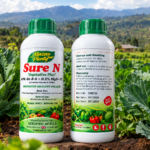
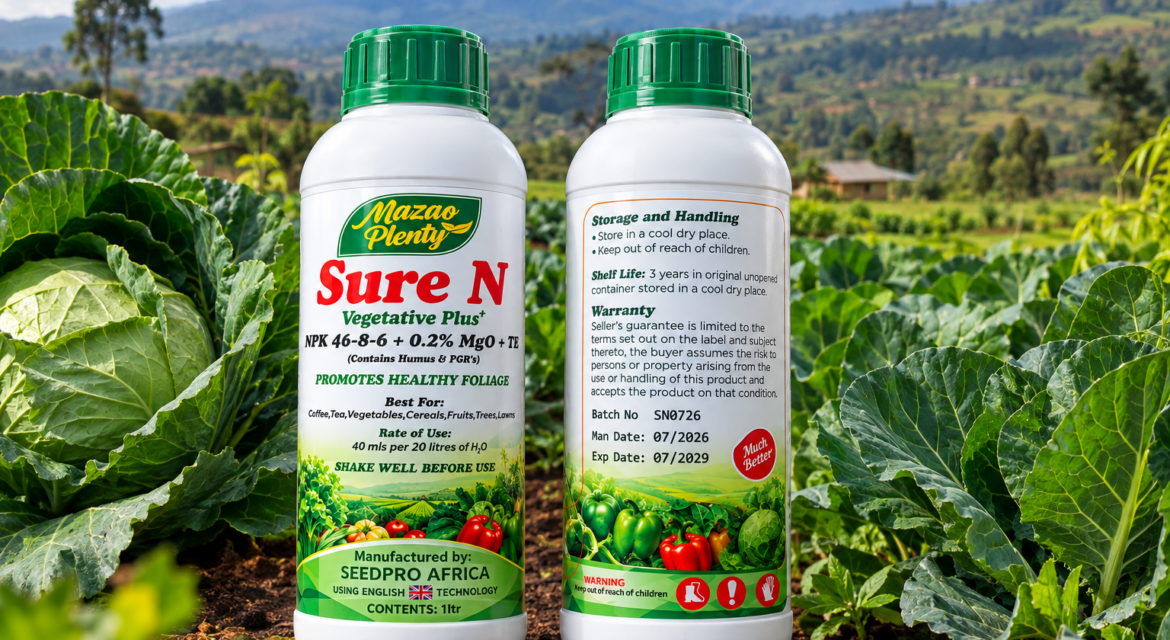
Products such as Sure Grow High Nitrogen can be considered where crops require nutritional support during vegetative growth. The formulation contains nitrogen together with other nutrients and micronutrients.
SeedPro also offers other crop nutrition products for different crop stages and nutritional requirements.
Farmers should always seek guidance on the appropriate product, rate and application timing instead of choosing a fertilizer based only on the name or nutrient percentage.
Why Proper Foliar Feeding Matters
Foliar fertilizers can be useful tools for farmers who understand when and how to use them.
The goal should not simply be to spray more fertilizer. The goal is to provide the crop with the nutrients it requires at the right stage and at the correct rate.
A good crop nutrition program combines soil fertility management, appropriate fertilizers, adequate water, pest and disease management, good agronomic practices and regular crop monitoring.
When these practices work together, farmers have a better opportunity to achieve healthy crops and good yields.
Looking for Foliar Fertilizers in Kenya?
If you are looking for foliar fertilizers in Kenya, SeedPro can help you choose a product based on your crop, crop stage and nutritional requirement.
Whether you are growing sukuma wiki, spinach, cabbage, tomatoes, capsicum, maize, onions or other crops, the right fertilizer should be selected according to the needs of the crop.
For guidance on the appropriate SeedPro product and how to use it, contact the SeedPro team on +254 119 098097.
SeedPro Kenya: Ni Siri Ya Mazao.
Frequently Asked Questions About Foliar Fertilizers
What are foliar fertilizers?
Foliar fertilizers are fertilizers applied directly to plant leaves through spraying. They provide a way of supplying nutrients to crops through the foliage.
What is the best foliar fertilizer?
The best foliar fertilizer depends on the crop, growth stage and nutritional requirement. There is no single formulation that is best for every crop.
Can I use foliar fertilizer on vegetables?
Yes. Foliar fertilizers can be used on many vegetables, including sukuma wiki, spinach, cabbage, tomatoes and capsicum, provided the product is suitable for the crop and applied according to its recommended rate.
How often should I apply foliar fertilizer?
The application interval depends on the product, crop and growth stage. Always follow the manufacturer’s recommended application schedule.
Can foliar fertilizer burn leaves?
Yes. Applying a fertilizer at a concentration higher than recommended can increase the risk of leaf damage. Correct measurement and application are therefore important.
Should I spray foliar fertilizer in the morning or evening?
Foliar applications are generally better suited to cooler parts of the day rather than periods of intense heat. Always consider the product instructions and local weather conditions.
Does foliar fertilizer replace DAP or other soil fertilizers?
Not necessarily. Foliar fertilizers are generally used as part of a broader crop nutrition program and should not automatically be considered a replacement for soil-applied fertilizers.
Where can I get foliar fertilizers in Kenya?
SeedPro fertilizers and crop nutrition products are available through SeedPro’s distribution network. Farmers can contact SeedPro on +254 119 098097 for guidance on the nearest stockist and the appropriate product for their crop.