 25 September 2026
Nitrogen for Leafy Vegetables: How Sure N Supports Sukuma Wiki, Cabbage and Spinach Growth
Nitrogen Fertilizer for Leafy Vegetables: Understanding the Role of Nitrogen in Sukuma Wiki, Cabbage and Spinach
When growing leafy vegetables such as sukuma wiki, cabbage, spinach, collards and other leafy greens, one thing quickly becomes obvious: the size, colour and continuous production of the leaves matter.
And behind healthy green foliage is an important plant nutrient: nitrogen.
Nitrogen is one of the essential macronutrients required by plants. It is closely associated with chlorophyll formation, leaf development and vegetative growth. When nitrogen is insufficient, vegetables can develop pale or yellowing leaves and reduced growth. Nitrogen deficiency commonly appears first on older leaves because nitrogen can move within the plant toward younger growing tissues.
But there is an important point farmers should understand.
More nitrogen does not automatically mean more harvest.
Vegetables need a balanced nutrition programme, and nitrogen should be supplied according to the crop, soil condition, growth stage and actual nutrient requirement.
Why nitrogen is important in sukuma wiki, cabbage and spinach
Leafy vegetables are grown largely for their foliage. That means the farmer is interested in producing healthy, actively growing leaves rather than simply getting a plant to survive.
Nitrogen contributes to the development of green foliage and new shoots. When nitrogen supply is inadequate, plants may become pale, growth can slow down and the crop may struggle to produce the amount of foliage expected by the farmer.
This is particularly important in crops such as sukuma wiki and spinach where farmers harvest leaves repeatedly.
Cabbage also requires good nutritional management during vegetative development because the plant needs to produce a strong canopy before forming a marketable head.
For a deeper guide on cabbage production, farmers can also read SeedPro’s article on how to grow heavy compact cabbage heads.
What happens when vegetables lack nitrogen?
One of the easiest symptoms for farmers to notice is loss of the deep green colour.
A nitrogen-deficient vegetable crop may have pale green or yellowing older leaves, slower growth and smaller foliage. However, yellow leaves do not always mean nitrogen deficiency. Other nutrient deficiencies, root problems, disease, waterlogging and unfavourable soil conditions can produce similar symptoms.
That is why diagnosis should come before simply adding more fertilizer. Soil and plant tissue testing can help determine whether the crop actually needs additional nutrients.
Introducing Mazao Plenty Sure N
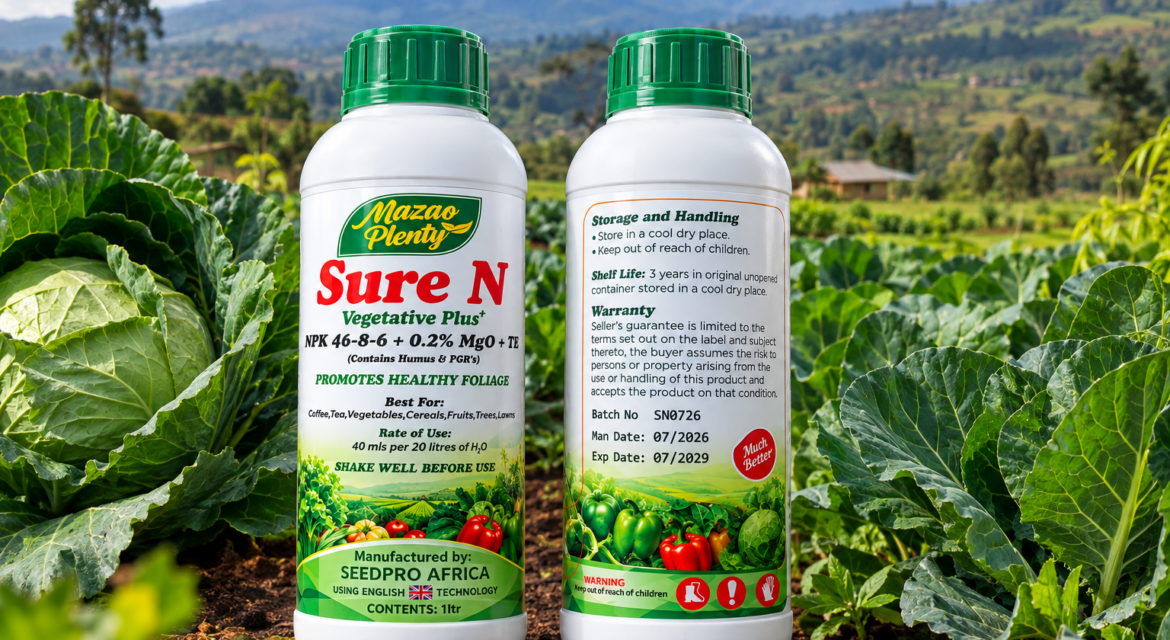
For farmers looking for a nitrogen-focused foliar fertilizer for leafy vegetables, Mazao Plenty Sure N Vegetative Plus is formulated with:
NPK 46:8:6 + 0.2% MgO + trace elements
The formulation also contains humus and PGRs, making it designed for the vegetative stage when crops are actively developing foliage.
Nitrogen is the dominant nutrient in the formulation, making Sure N particularly relevant to farmers managing crops where vigorous vegetative growth is an important production objective.
The magnesium component is also relevant because magnesium is associated with chlorophyll and photosynthetic activity. The formulation’s trace elements provide additional micronutrient support, although micronutrient requirements vary between crops and soils.
What about the PGRs?
PGR stands for Plant Growth Regulators.
PGRs are substances that can influence plant growth and development. Their effects depend on the particular active ingredients, crop, concentration and timing of application.
In Sure N, PGRs form part of the formulation alongside the nutrient components. The objective is not simply to supply nitrogen, but to provide a vegetative-stage product designed around crop growth.
However, farmers should always follow the product label when using products containing PGRs because concentration and timing are important.
Sure N application rate
According to the product label shown, the recommended rate for Sure N is:
40 ml per 20 litres of water.
Farmers should shake the product well before use and follow the label directions for application.
Foliar feeding should be viewed as part of an overall crop nutrition programme, not automatically as a replacement for good soil fertility management. Research and extension guidance indicates that the majority of vegetable nutrient requirements should normally come through the root zone, while foliar feeding can supplement nutrition or help address particular deficiencies.
Farmers can also explore the SeedPro guide on unlocking nutrients in soil through organo-mineral fertilizers.
When should a farmer use a nitrogen foliar feed?
Timing depends on the crop and its nutrition programme.
For leafy vegetables, the vegetative stage is particularly important because this is when the plant is developing its leaves and canopy.
A farmer should also consider what has already been applied to the soil. If the crop already has adequate nitrogen, adding more simply because the leaves look green may not provide an advantage. Excessive nitrogen application can also create nutrient-management and environmental problems. Recent research on leafy vegetables highlights the importance of balancing nitrogen supply rather than assuming that maximum nitrogen always produces maximum performance.
Do not forget the soil
A good vegetable nutrition programme starts from the soil.
Before planting sukuma wiki, cabbage or spinach, farmers should consider soil fertility, pH, organic matter, moisture and the availability of major and micronutrients.
For crops such as leafy vegetables, nitrogen is important, but it works alongside phosphorus, potassium, calcium, magnesium, sulfur and micronutrients.
That is why farmers should think beyond “NPK” and look at the entire nutrition programme.
For more information on foliar nutrition, the Penn State Extension guide on foliar fertilization in vegetable production provides useful background on when foliar feeding can be beneficial.
Give your leafy vegetables the nutrition they need
If your crop is at the vegetative stage and you are managing sukuma wiki, spinach, cabbage, collards or other leafy vegetables, nutrition deserves serious attention.
Mazao Plenty Sure N Vegetative Plus provides a nitrogen-focused formulation of NPK 46:8:6 + 0.2% MgO + trace elements, with humus and PGRs, designed for the vegetative growth stage.
Remember, a productive vegetable crop is not created by nitrogen alone. Good soil preparation, adequate moisture, proper spacing, pest and disease management, balanced nutrition and correct application timing all work together.
Sure N. Feed the foliage. Build the crop. Grow with SeedPro.
For SeedPro products and agricultural support, visit SeedPro Kenya or contact +254 119 098097.
Ni Siri Ya Mazao.