 01 July 2026
Complete Avocado Farming Guide in Kenya: The Best Nutrition Program from Planting to Harvest
Avocado farming has become one of the most profitable agricultural ventures in Kenya. With the increasing demand for Hass avocados in export markets and local consumption continuing to rise, many farmers are establishing new orchards or expanding existing ones. However, while planting quality seedlings is important, achieving high yields and premium fruit quality depends largely on proper crop nutrition throughout the life of the tree.
One of the biggest mistakes avocado farmers make is believing that fertilizer is only needed during planting. In reality, avocado trees require different nutrients at different growth stages. Supplying the correct nutrients at the right time results in stronger roots, healthier canopies, improved flowering, better fruit set, larger fruits, and higher profitability.
This guide explains a complete avocado nutrition program from land preparation to harvesting, helping farmers maximize productivity while maintaining healthy trees.
Why Proper Nutrition Matters in Avocado Farming
Every avocado tree is like a factory. The healthier the factory, the more quality fruits it produces.
When nutrition is inadequate, farmers often experience problems such as:
- Poor root development
- Slow tree growth
- Yellowing leaves
- Weak flowering
- Flower drop
- Poor fruit set
- Small fruits
- High fruit abortion
- Reduced yields
Balanced nutrition allows the tree to maintain vigorous growth while supporting fruit production without exhausting itself.
A complete nutrition program helps ensure:
- Strong root establishment
- Healthy canopy development
- Continuous flowering
- Excellent fruit set
- Uniform fruit growth
- Better fruit quality
- Increased harvests
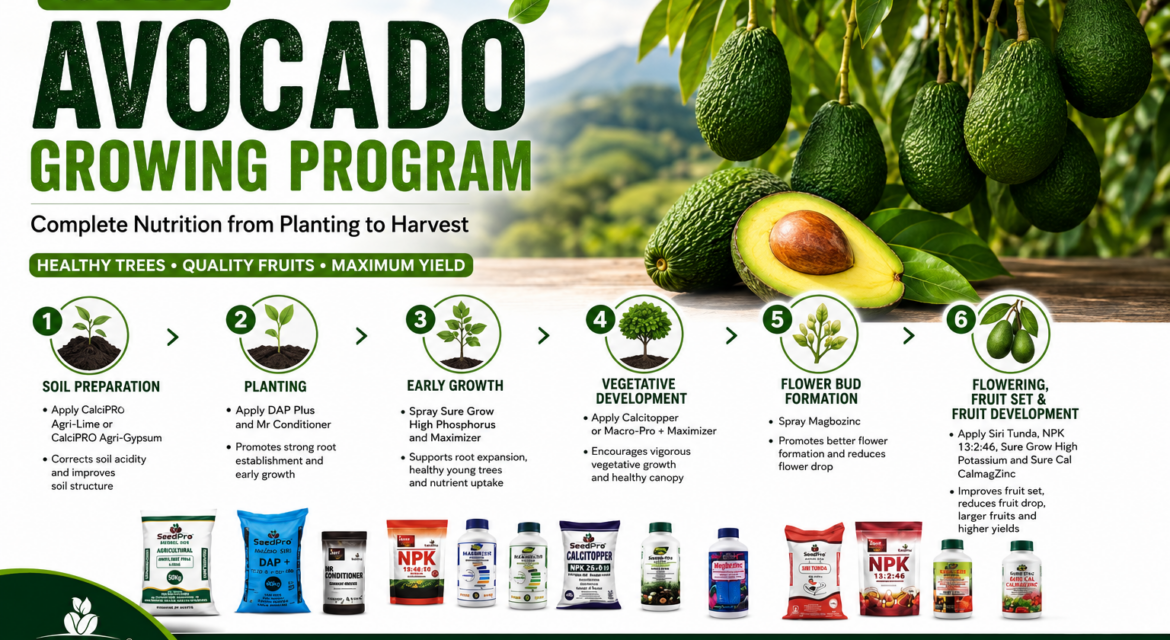
Stage 1: Soil Preparation
Successful avocado farming begins before planting.
Healthy soil forms the foundation of every productive orchard. Before transplanting seedlings, farmers should assess soil conditions and correct any nutrient imbalances.
Where soils are acidic, applying agricultural lime helps raise soil pH, improving nutrient availability and encouraging healthy root development. In soils that require both calcium and sulphur, agricultural gypsum is an excellent option for improving soil structure and root penetration.
Proper soil preparation provides several benefits:
- Corrects soil acidity
- Improves calcium availability
- Enhances root establishment
- Improves soil structure
- Encourages beneficial microbial activity
Strong roots established early will support the tree throughout its productive life.
Stage 2: Planting
Once the land is prepared, attention shifts to transplanting.
Young avocado seedlings require readily available phosphorus to stimulate rapid root development. Applying an organo mineral DAP fertilizer during planting encourages vigorous root growth while improving nutrient uptake.
Adding a soil conditioner during this stage further improves moisture retention and supports beneficial soil organisms.
A good planting program helps achieve:
- Fast rooting
- Strong early establishment
- Better transplant survival
- Improved nutrient uptake
Healthy seedlings establish quickly and begin vegetative growth much earlier.
Stage 3: Early Growth
During the early growth stage, the focus is building a healthy framework for future production.
Trees require sufficient nitrogen and phosphorus to encourage vigorous canopy development while maintaining strong roots.
A balanced foliar nutrition program helps:
- Promote strong root expansion
- Accelerate canopy development
- Improve nutrient uptake
- Build healthy young trees
Farmers often underestimate this stage, yet it determines how quickly trees reach production age.
Stage 4: Vegetative Development
As avocado trees become established, vigorous vegetative growth becomes essential.
This is the period when branches, leaves, and stems develop rapidly.
Balanced nutrition during this stage encourages:
- Vigorous vegetative growth
- Healthy green leaves
- Strong branches
- Improved nutrient efficiency
Calcium plays a particularly important role during vegetative development by strengthening plant tissues and supporting healthy cell formation.
Trees with healthy canopies are better able to manufacture food through photosynthesis, ultimately supporting higher fruit production.
Stage 5: Flower Bud Formation
Many avocado farmers lose potential yields before flowering even begins.
Flower buds require specialized nutrition to develop properly.
Applying nutrients that support reproductive growth helps achieve:
- Better flower formation
- Increased pollen viability
- Improved flower retention
- Enhanced bud development
Healthy flowers significantly increase the chances of successful pollination and fruit set.
Skipping this stage often results in excessive flower drop and fewer fruits.
Stage 6: Flowering, Fruit Set and Fruit Development
This is arguably the most important stage of avocado production.
Once flowering begins, the tree’s nutritional demand increases dramatically.
Proper nutrition during flowering and fruit development supports:
- Better fruit set
- Reduced fruit abortion
- Larger fruit size
- Improved fruit firmness
- Better fruit colour
- Longer shelf life
- Higher marketable yield
Potassium becomes especially important during this stage because it assists in fruit filling, sugar movement, and overall fruit quality.
Calcium also contributes to firmer fruits and reduces post-harvest losses.
Balanced nutrition throughout fruit development results in uniform fruits that meet export market standards.
Common Mistakes That Reduce Avocado Yields
Even experienced farmers can unknowingly reduce production by making avoidable mistakes.
Some of the most common include:
- Applying fertilizer only once a year.
- Ignoring soil acidity.
- Overapplying nitrogen during flowering.
- Failing to supply calcium.
- Waiting until trees show deficiencies before feeding them.
- Using the same fertilizer throughout every growth stage.
- Neglecting foliar nutrition.
Each growth stage requires a different nutritional approach.
How to Maximize Avocado Production
Farmers who consistently harvest high yields usually follow a complete nutrition program rather than relying on a single fertilizer application.
For the best results:
- Prepare your soil before planting.
- Feed young trees for strong establishment.
- Build a healthy canopy during vegetative growth.
- Support flower formation with balanced nutrition.
- Supply adequate potassium and calcium during fruit development.
- Monitor your orchard regularly for nutrient deficiencies.
Consistent nutrition allows trees to remain productive for many years while maintaining excellent fruit quality.
Final Thoughts
Successful avocado farming is not simply about planting seedlings and waiting for harvest. Every stage of crop development has unique nutritional requirements that directly influence yield, fruit quality, and profitability.
A complete nutrition program helps farmers establish stronger trees, improve flowering, increase fruit set, reduce fruit drop, and produce larger, higher-quality avocados that meet both local and export market standards.
By providing the right nutrients at the right growth stage, farmers can maximize returns while ensuring the long-term health and productivity of their orchards.
Whether you are establishing a new orchard or managing mature avocado trees, investing in proper nutrition is one of the smartest decisions you can make for a successful avocado farming enterprise.