 15 October 2026
Best Foliar Fertilizers in Kenya: A Complete Guide to Sure Grow Foliar Feeds
Are you looking for the best foliar fertilizers in Kenya for your sukuma wiki, tomatoes, capsicum, onions, maize or other crops? Choosing the right foliar feed can make a difference in how you manage crop nutrition, especially when your plants need specific nutrients at different stages of growth.
Kenyan farmers can find many products marketed as folia feeds, folia fertilizers, foliar boosters and plant nutrition sprays. However, the best choice is not necessarily the most expensive fertilizer or the one with the highest nutrient percentage. It is the product that matches your crop’s nutritional needs, growth stage and existing fertilizer programme.
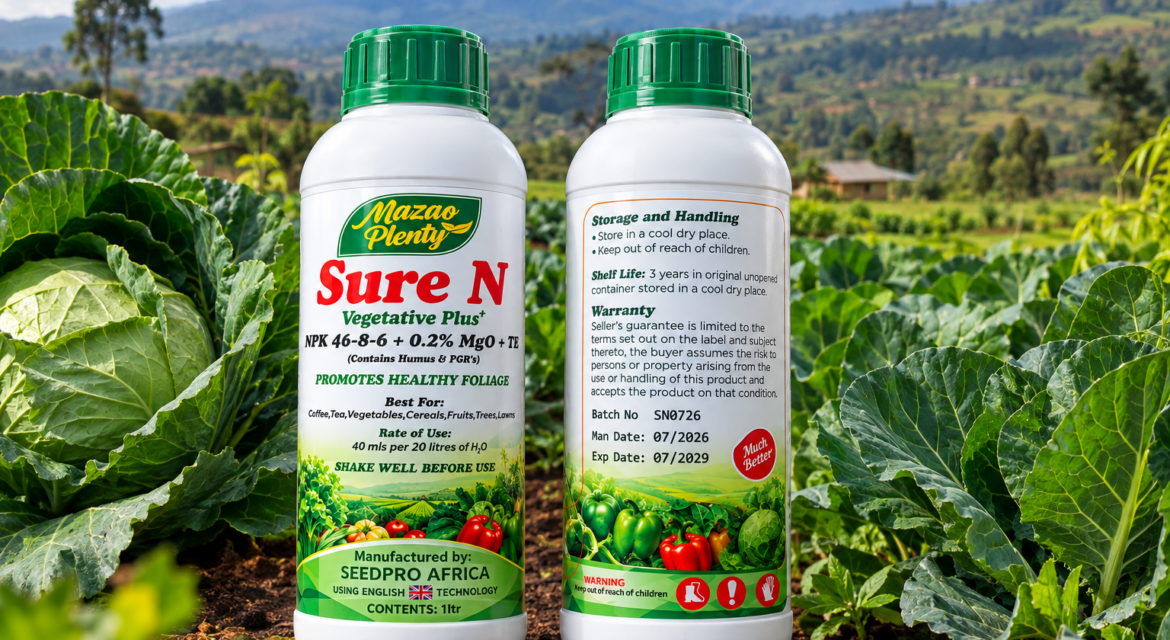
At SeedPro Africa, the Sure Grow range includes High Nitrogen, Standard 20:20:20, High Phosphorus, High Potassium and High Calcium foliar fertilizers. Each formulation is intended for a different nutritional purpose.
This guide explains what foliar fertilizers do, how to choose the right Sure Grow foliar feed and what farmers should consider before spraying their crops.
What Are Foliar Feeds and Foliar Fertilizers?
Foliar feeds are fertilizers applied directly to plant leaves using a sprayer. The nutrients are absorbed through the leaf surface, allowing plants to take up certain nutrients without relying entirely on absorption through their roots.
Farmers often search online for terms such as “folia fertilizers in Kenya”, “best folia feed”, “foliar feeds for vegetables” and “best foliar fertilizer for tomatoes”. These searches usually come from farmers who want to improve crop growth, address a nutrient deficiency or support their crops during particular growth stages.
Foliar feeding can complement soil-applied fertilizers. It should not automatically replace basal fertilizer or soil nutrition because crops need substantial quantities of nutrients throughout their growth cycle, and leaves cannot always supply everything the plant requires.
The correct foliar fertilizer depends on the nutrient needed, the crop, its growth stage and the instructions on the product label.
Why Do Farmers Need Different Types of Foliar Fertilizers?
A maize plant producing leaves has different nutritional priorities from a tomato plant developing flowers and fruits. Similarly, sukuma wiki grown for continuous leaf harvesting may require a different nutrition strategy from onions approaching bulb development.
The three primary plant nutrients are nitrogen, phosphorus and potassium. Calcium is also essential for plant cell structure and normal growth.
This is why using one foliar fertilizer for every crop and every stage may not always be the best approach.
The Sure Grow foliar feed range offers farmers different formulations to consider according to their crop nutrition needs.
1. Sure Grow High Nitrogen Foliar Fertilizer
Nitrogen is essential for chlorophyll formation, protein synthesis and the development of leaves and stems. It is particularly important during active vegetative growth.
Sure Grow High Nitrogen is a foliar feed option for farmers who need to supplement nitrogen nutrition during stages when crops are actively producing vegetative growth.
Which crops can benefit from nitrogen nutrition?
Farmers growing sukuma wiki, spinach, cabbage and other leafy vegetables need to pay attention to nitrogen because they harvest the leaves. Maize also needs sufficient nitrogen to develop its canopy and support grain production.
Tomatoes and capsicum require nitrogen during vegetative growth, but excessive nitrogen can encourage too much leaf growth at the expense of balanced flowering and fruit development.
A foliar feed containing nitrogen may be useful where the formulation matches the crop’s requirements. However, nitrogen deficiency should be distinguished from other problems such as poor root development, waterlogging, drought or unsuitable soil pH.
When should you use High Nitrogen?
Consider it when the crop requires additional nitrogen and the product label supports its use at that stage. Foliar feeding is a supplement to a suitable soil fertility programme, not a substitute for all the nitrogen the crop needs.
2. Sure Grow Standard 20:20:20 Foliar Fertilizer
What if your crop needs a more balanced supply of the three primary nutrients?
Sure Grow Standard 20:20:20 is a balanced NPK foliar feed formulation. The numbers indicate the declared percentages of nitrogen, phosphate expressed as P₂O₅, and potash expressed as K₂O, respectively, subject to the product label.
Nitrogen supports vegetative growth, phosphorus contributes to energy transfer and root development, while potassium supports water regulation, enzyme activity and several processes involved in crop quality.
When is a balanced 20:20:20 foliar fertilizer useful?
A balanced formulation may be considered where a crop needs supplementary nutrition involving all three primary nutrients. Its suitability depends on the crop, the growth stage, the soil fertility status and the composition of the complete fertilizer programme.
For example, farmers growing tomatoes, capsicum and other vegetables should assess their plants’ needs before deciding whether a balanced foliar feed is appropriate.
A balanced NPK formulation is not automatically the best choice for every crop stage. If the crop has a specific nutrient deficiency, a targeted formulation may be more appropriate.
3. Sure Grow High Phosphorus Foliar Fertilizer
Phosphorus is involved in energy transfer, root development and other important plant processes. It is essential from early plant establishment through subsequent growth stages.
Sure Grow High Phosphorus is an option to consider when supplementary phosphorus nutrition is required and the product is suitable for the crop and application stage.
Why is phosphorus important?
Phosphorus contributes to root growth and energy transfer within the plant. Adequate phosphorus nutrition is important for establishment and reproductive development, although the precise requirements vary by crop and growth stage.
Farmers should remember that phosphorus deficiency does not always mean the soil contains too little phosphorus. In some Kenyan soils, phosphorus may be present but poorly available because of soil pH and interactions with iron, aluminium or calcium.
Where soil phosphorus is unavailable, a foliar feed may provide supplementary nutrition, but it will not correct every underlying soil problem.
Important: Do not assume that every phosphorus-rich foliar fertilizer is a complete planting fertilizer. Follow the product label and maintain an appropriate soil-applied fertilizer programme.
4. Sure Grow High Potassium Foliar Fertilizer
Potassium plays several important roles in plant water regulation, enzyme activity, nutrient movement and crop development. It is particularly relevant to crop quality and the management of water stress, although it cannot replace adequate irrigation or rainfall.
Sure Grow High Potassium is a formulation to consider when additional potassium nutrition is required.
Which crops may need potassium nutrition?
Tomatoes and capsicum require potassium throughout their growth cycle, including during fruit development. Onions also need adequate potassium as bulbs develop. Potassium is important in maize for water regulation, enzyme activity and grain production.
Other crops, including potatoes and fruit crops, also require sufficient potassium according to their production targets and soil fertility conditions.
A high-potassium foliar fertilizer may complement the crop’s wider nutrition programme where appropriate. It does not mean the farmer should ignore nitrogen, phosphorus, calcium or other essential nutrients.
The timing and frequency of application should follow the product label and the nutritional requirements of the crop.
5. Sure Grow High Calcium Foliar Fertilizer
Calcium is an essential nutrient that contributes to cell wall structure, membrane function and normal growing-point development.
Sure Grow High Calcium is an option for farmers who need supplementary calcium nutrition, provided the formulation is appropriate for the crop and the intended application.
Why is calcium important for tomatoes and capsicum?
Tomatoes and capsicum require calcium for normal fruit development. Inadequate calcium delivery to developing fruit is associated with blossom-end rot, a disorder that appears as a dark, sunken area at the blossom end of the fruit.
However, blossom-end rot does not necessarily mean the soil lacks calcium. Irregular watering, root damage, salinity and rapid changes in plant water demand can interfere with calcium delivery to developing fruit.
Calcium is relatively immobile in the plant, so spraying leaves does not guarantee that sufficient calcium will reach the developing fruit. Farmers should manage moisture consistently, protect healthy roots and follow crop-specific calcium recommendations.
Calcium nutrition is also important for other crops, but the appropriate application strategy differs by crop and formulation.
How Do You Choose the Best Foliar Fertilizer for Your Crop?
Before buying folia feeds in Kenya, ask three questions.
First, what crop are you growing? Sukuma wiki, maize, tomatoes, onions and capsicum have different nutritional requirements.
Second, what growth stage is the crop in? Establishment, vegetative growth, flowering, fruit development and maturity may require different nutrition strategies.
Third, what nutritional problem are you trying to address? A nitrogen deficiency requires a different response from a calcium deficiency or inadequate potassium nutrition.
Here is a simple guide to help you compare the Sure Grow range.
| Sure Grow foliar feed | Main nutritional focus | What to consider |
|---|---|---|
| High Nitrogen | Nitrogen | Supplementary nitrogen during appropriate vegetative growth stages |
| Standard 20:20:20 | Balanced NPK | Situations requiring supplementary nitrogen, phosphorus and potassium |
| High Phosphorus | Phosphorus | Crop-specific phosphorus supplementation |
| High Potassium | Potassium | Supplementary potassium nutrition according to crop requirements |
| High Calcium | Calcium | Calcium nutrition and crop-specific calcium management |
This is a general selection guide, not a replacement for the product label or a crop-specific recommendation.
How to Apply Foliar Fertilizers Correctly
Even the right foliar feed can disappoint when it is applied incorrectly.
Follow these practices when spraying foliar fertilizers:
- Read the product label. Confirm the recommended crop, application rate, mixing instructions and frequency before spraying.
- Use the correct concentration. More fertilizer does not necessarily mean better results. Excessive concentrations can scorch leaves.
- Spray under suitable weather conditions. Avoid spraying during intense heat or when strong wind may carry the spray away. Follow the label’s weather guidance.
- Calibrate your knapsack sprayer. Accurate measurement helps ensure consistent application.
- Check compatibility before mixing products. Do not combine fertilizers, pesticides or other products unless compatibility is established.
- Observe the crop after application. Watch for leaf injury or other unexpected reactions and seek agronomic advice if problems arise.
Do not assume that every Sure Grow formulation has the same application rate. Use the specific product instructions for the formulation you have purchased.
Can Foliar Fertilizers Replace Soil Fertilizers?
No, not in most crop production systems.
Foliar feeding can be useful for supplementary nutrition, but crops generally require an adequate supply of nutrients through their roots. Soil-applied fertilizers, organic matter management, appropriate irrigation and good root health remain important parts of crop nutrition.
For example, maize requires sufficient nitrogen, phosphorus, potassium and other nutrients to support its growth and grain development. A foliar spray alone cannot reliably provide all the nutrients required for a productive maize crop.
Likewise, vegetable farmers should not rely exclusively on foliar fertilizers when their crops need a complete soil fertility programme.
The most effective approach is to assess the crop’s needs and combine appropriate soil nutrition with foliar feeding where necessary.
Why Choose Sure Grow Foliar Feeds from SeedPro?
Choosing a foliar fertilizer should begin with understanding what your crop needs. SeedPro’s Sure Grow range gives farmers different formulations to consider, from High Nitrogen and Standard 20:20:20 to High Phosphorus, High Potassium and High Calcium.
Rather than selecting a product simply because another farmer uses it, consider your crop, its growth stage, the soil fertility situation and the purpose of the application.
The right nutrition programme can help farmers make better decisions about fertilizer use, avoid unnecessary applications and manage crop nutrition more carefully.
For farmers looking for folia feeds, folia fertilizers or foliar fertilizers in Kenya, Sure Grow provides options to discuss with a qualified agronomist.
Frequently Asked Questions About Foliar Fertilizers in Kenya
What is the best foliar fertilizer in Kenya?
There is no single best foliar fertilizer for every crop. The right product depends on the crop, growth stage, nutrient requirements and the formulation’s suitability. Sure Grow offers High Nitrogen, Standard 20:20:20, High Phosphorus, High Potassium and High Calcium options.
Which foliar fertilizer is best for sukuma wiki?
Sukuma wiki needs sufficient nitrogen to support leaf production, alongside phosphorus, potassium and other essential nutrients. Sure Grow High Nitrogen may be considered when additional nitrogen is required, but the complete nutrition programme should address all the crop’s needs.
Which foliar fertilizer is suitable for tomatoes?
Tomatoes require balanced nutrition throughout establishment, vegetative growth, flowering and fruit development. A balanced 20:20:20 formulation or a targeted nutrient formulation may be appropriate depending on the stage and the nutritional problem. Calcium management also matters, particularly when preventing blossom-end rot.
What is the difference between foliar fertilizer and soil fertilizer?
Foliar fertilizers are applied to leaves, while soil fertilizers are applied to the soil for nutrient uptake mainly through roots. The two approaches can complement each other, but foliar feeding does not normally replace the crop’s complete soil nutrition requirements.
Can I mix different foliar feeds in one knapsack?
Do not assume that different formulations can be mixed safely. Compatibility depends on the products’ chemical composition, concentration and water quality. Check the product labels and obtain technical advice before combining them.
How often should I spray foliar fertilizer?
The correct frequency depends on the specific product, crop, growth stage and nutritional requirements. Always follow the label instead of using the same spraying interval for every formulation.
Get the Right Sure Grow Foliar Feed for Your Farm
Are you growing sukuma wiki, tomatoes, capsicum, onions, maize or another crop? The right foliar fertilizer depends on what your crop needs at its current growth stage.
Contact SeedPro Africa for guidance on the Sure Grow foliar feed range and ask which formulation is suitable for your crop nutrition programme.
SeedPro Africa: Ni Siri Ya Mazao.