 21 September 2026
Bean Farming in Kenya: A Complete Guide to Planting, Spacing, Fertilizer, Nutrition and Higher Yields
Bean Farming in Kenya: A Complete Guide to Planting, Fertilizer, Spacing and Higher Yields
Beans are among the most important food and cash crops grown by farmers across Kenya. From smallholder farms to commercial farms, beans remain popular because they mature relatively quickly, provide an important source of protein and can be grown either as a sole crop or intercropped with crops such as maize.
However, successful bean farming in Kenya is not simply about putting seed in the ground when the rains start. Good yields depend on several decisions made before and after planting — including variety selection, land preparation, spacing, soil fertility, weed management, moisture management and crop nutrition.
With the planting season approaching or already underway in many parts of Kenya, this is the right time to prepare your bean farming program.
KALRO recommends planting beans at the onset of rains and gives a general monocrop spacing of 50 cm between rows and 10 cm between plants, with planting depth generally around 2.5–5 cm.
In this guide, we take you through how to grow beans in Kenya from planting to flowering and pod development, including how SeedPro products such as DAP Plus, Siri Planta, Maximizer, Sure P, Macro Pro, Sure K and Magbozinc can fit into a bean nutrition programme.
1. Choose the Right Bean Variety for Your Area
Before buying fertilizer, choose a bean variety that is suitable for your location, market and growing conditions.
Kenyan farmers grow different types of beans, including Rosecoco, Nyota, Angaza, Faida, red kidney types, white beans and other locally adapted varieties. KALRO’s bean resources emphasize selecting varieties suited to the farmer’s agro-ecological zone and market requirements.
Consider:
- Disease resistance
- Maturity period
- Market demand
- Seed quality
- Yield potential
- Drought or climate suitability
- Whether you are growing for dry grain or green bean production
Always purchase clean, certified or quality-assured seed where possible. Avoid planting seed that is rotten, discoloured, badly damaged or mixed with other varieties.
2. Prepare Your Land Before Planting
Beans perform best in well-prepared soil with good drainage.
Prepare the field early enough so that planting can be done as soon as the rains provide suitable moisture. Beans do not perform well in waterlogged conditions, so avoid areas where water remains standing after rainfall.
Before planting, consider carrying out a soil test. Soil testing can help determine the nutrients already available and whether amendments or fertilizer are required. KALRO also recommends soil analysis when developing fertilizer recommendations for beans.
Good land preparation should aim to:
- Break large soil clods
- Provide a fine seedbed
- Improve seed-to-soil contact
- Remove early weeds
- Maintain good drainage
- Incorporate well-decomposed organic matter where appropriate
For more information on fertilizer and soil management, farmers can also read SeedPro’s guide on organo-mineral fertilizers in Kenya.
3. When Should You Plant Beans in Kenya?
For rain-fed bean farming, timing is extremely important.
Generally, beans should be planted at the onset of reliable rains rather than waiting until much later in the season. KALRO guidance notes that early planting helps beans establish before some pest and disease pressures increase, while delayed planting can expose the crop to additional production risks.
The exact planting date will depend on your county and rainfall pattern.
If the soil has adequate moisture and weather conditions are suitable, avoid unnecessary delays.
4. What Is the Best Spacing for Beans?
One of the most searched questions by Kenyan bean farmers is: What is the correct spacing for beans?
For common beans grown as a sole crop, KALRO recommends approximately:
50 cm between rows × 10 cm between plants
with one seed per station under the referenced production system. Planting depth is generally around 2.5–5 cm, depending on soil conditions.
Spacing is important because overcrowding can increase competition for light, water and nutrients while also reducing airflow through the crop.
On the other hand, extremely wide spacing can reduce the plant population and leave too much bare soil.
Always adjust recommendations according to the variety, seed size, soil type, production system and agronomic advice for your area.
5. Can You Intercrop Beans With Maize?
Yes. Beans and maize are commonly intercropped in Kenya.
For farmers with limited land, bean-maize intercropping can allow two crops to occupy the same field during the season.
KALRO guidance provides specific arrangements for intercropping beans with maize, including placing bean rows between maize rows while maintaining appropriate maize spacing for the agro-ecological zone.
Beans can also be incorporated into other farming systems depending on the farm and local conditions.
However, remember that intercrops compete for light, water and nutrients. Avoid creating excessive plant populations simply because there is space between rows.
Good intercropping starts with planned spacing, not simply mixing seeds together.
6. Fertilizer Program for Beans: Start With Strong Roots
Bean plants may fix atmospheric nitrogen through their root nodules, but that does not mean beans require no fertilizer.
Beans still need nutrients such as phosphorus, potassium, calcium, magnesium, sulphur and micronutrients for healthy growth and production.
The exact fertilizer requirement should ideally be based on soil testing.
For farmers using the SeedPro approach, the nutrition programme can be organized around the different stages of bean development.
Stage 1: Planting — DAP Plus or Siri Planta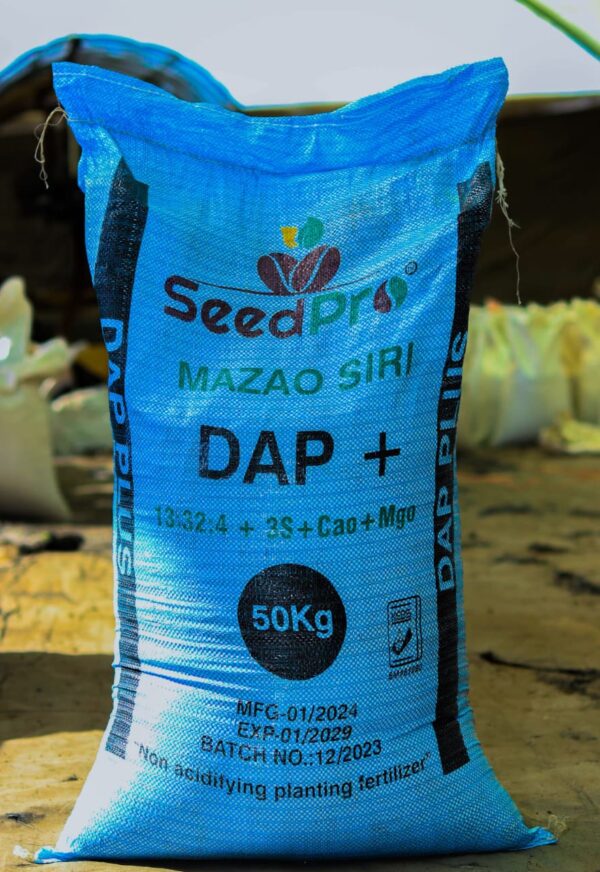
At planting, the objective is to establish a strong crop with a healthy root system.
Two SeedPro options that can fit into the planting stage are DAP Plus and Siri Planta, depending on the soil condition, fertilizer recommendation and overall programme.
DAP Plus
SeedPro’s DAP Plus is formulated at 13:32:4, with sulphur, calcium oxide and magnesium oxide. Its relatively high phosphorus content makes it relevant for the establishment stage, when the developing bean crop is building its root system.
For beans, good early root development is important because the root system supports water and nutrient uptake throughout the crop cycle.
SeedPro’s published bean programme recommends DAP Plus at planting and highlights its role in root development and early crop vigour.
Important: Do not place fertilizer directly against the seed. Mix or position fertilizer correctly according to the product instructions to reduce the risk of seed injury.
Siri Planta
Another planting option is Siri Planta NPK 10:24:4, formulated with calcium, magnesium and sulphur. SeedPro describes Siri Planta as a general-use planting fertilizer.
The phosphorus component supports early root development, while the additional nutrients contribute to balanced crop nutrition.
Do not automatically use both DAP Plus and Siri Planta together. Choose the appropriate planting fertilizer based on soil-test results, crop requirements and professional agronomic advice.
7. Early Growth: Use Maximizer and Sure P
Once the beans have emerged and established, attention shifts from simply getting the crop out of the ground to building a healthy plant.
This is where Maximizer and Sure P can become useful components of the SeedPro nutrition programme.
Maximizer
Maximizer is a SeedPro biostimulant positioned to support crop performance and stress management. SeedPro describes it as a crop stress reliever that enhances crop performance.
For young beans, this can be useful when the crop experiences stresses such as:
- Heavy rainfall
- Temporary moisture stress
- Temperature fluctuations
- Poor early establishment
- Other environmental stresses
Maximizer should complement fertilizer nutrition rather than replace it.
Sure P
Sure P is a phosphorus-focused foliar fertilizer. SeedPro’s published crop programmes describe Sure P as supporting root development and energy transfer within plants.
For beans, phosphorus is particularly important during early development because the crop is building its root system and preparing for later reproductive growth.
The SeedPro bean programme gives a specific example of Sure P being used during early growth. Always follow the current product label for the correct application rate and compatibility before spraying.
8. Vegetative Growth: Build a Healthy Bean Canopy
The vegetative stage is when your bean crop is developing leaves, branches and overall plant structure.
A healthy canopy matters because leaves capture sunlight and produce the energy the crop needs for continued development and eventual pod production.
This is where Macro Pro can form part of the foliar nutrition programme.
SeedPro lists Macro Pro as an NPK foliar fertilizer with a 25:25:20 NPK formulation, 0.2% MgO and trace elements. It is listed for several crops, including cereals, vegetables, fruits and tree crops.
For beans, a balanced foliar feed can complement the soil-applied fertilizer programme during active growth.
The goal is not simply to make the crop look greener. The objective is to maintain balanced nutrition as the crop moves toward flowering.
9. Flowering Stage: Pay Attention to Potassium
Flowering is one of the most important stages in bean production.
The crop now begins shifting resources toward flowers and eventually pods. Poor nutrition, moisture stress and other stresses at this stage can affect flowering and pod formation.
This is where Sure K can be incorporated into a stage-based nutrition programme.
SeedPro’s Sure K formulation is NPK 10:9:47 + 0.2% MgO, making it a high-potassium foliar fertilizer. SeedPro positions Sure K for flower and fruit formation.
Potassium plays important roles in plant water regulation, enzyme activity and movement of nutrients within plants. In beans, adequate potassium nutrition supports the crop as it transitions through flowering and pod development.
Do not wait until the crop is already severely stressed. Nutrition should be planned before the crop reaches its most demanding stages.
10. Where Does Magbozinc Fit in Bean Farming?
Not every yellow leaf means you need to add more fertilizer.
Beans can experience nutrient deficiencies depending on soil fertility, pH, moisture, root development and previous cropping history.
Magbozinc can be useful where magnesium, zinc or related micronutrient deficiencies are suspected or confirmed.
SeedPro describes Magbozinc as a foliar fertilizer containing magnesium and zinc and positions it for correcting deficiencies and supporting crop performance.
Look out for symptoms such as:
Nitrogen deficiency
Older leaves may become pale or yellow, with reduced plant growth.
Phosphorus deficiency
Plants may show poor development, weak roots and, under some conditions, purplish coloration.
Potassium deficiency
Older leaves can develop yellowing or browning along the margins, while the crop may also show reduced performance during pod development.
Magnesium deficiency
Yellowing between the veins of older leaves can be associated with magnesium deficiency.
Zinc deficiency
Young leaves may become smaller or show abnormal growth, depending on severity.
However, visual symptoms alone are not always enough to diagnose a deficiency because nutrient problems can resemble disease, herbicide injury, drought stress or root damage.
If possible, confirm suspected deficiencies through soil or plant analysis and seek agronomic advice before applying corrective products.
11. Weed Management Is Critical
Weeds compete directly with beans for water, nutrients, light and space.
KALRO production guidance recommends timely weeding, with one intervention around two weeks after emergence and another before flowering under the referenced production system.
Avoid unnecessary disturbance of the crop during flowering, particularly where it could lead to flower damage.
Keep the field clean during early crop development so that beans can establish without heavy competition.
12. Do Not Ignore Moisture Management
Fertilizer cannot compensate for severe moisture stress.
Beans need adequate moisture for germination, establishment, flowering and pod development. At the same time, excessive water and poor drainage can create problems.
For rain-fed farmers, planting at the beginning of reliable rains is therefore important.
Where irrigation is available, maintain consistent moisture according to soil and crop conditions rather than allowing the crop to repeatedly move between severe dryness and excessive wetness.
13. A Simple SeedPro Bean Nutrition Roadmap
A practical programme can be structured as follows:
| Bean growth stage | SeedPro product | Main purpose |
|---|---|---|
| Planting | DAP Plus OR Siri Planta | Establishment and root development |
| Early growth | Maximizer | Support crop performance and stress management |
| Early growth | Sure P | Phosphorus support and root development |
| Vegetative growth | Macro Pro | Balanced NPK and trace-element support |
| Flowering/pod development | Sure K | High-potassium support during reproductive development |
| Where deficiency is suspected | Magbozinc | Magnesium/zinc nutritional support |
This should be treated as a stage-based framework rather than a fixed prescription. Fertilizer rates and spray intervals should follow the current SeedPro product label, soil-test recommendations and professional agronomic advice.
14. Harvesting Beans
Beans should be harvested at the correct maturity stage to protect grain quality.
For dry beans, allow the pods to mature and dry appropriately before harvesting. KALRO guidance recommends drying harvested beans further before threshing and protecting the grain from contamination during drying.
After threshing:
- Remove damaged grains
- Remove rotten or diseased grains
- Remove insect-damaged grains
- Dry the beans properly
- Store them in clean, dry conditions
- Protect them from storage pests
Good production does not end when the beans leave the field. Poor post-harvest handling can reduce the value of an otherwise healthy crop.
Final Word: Start Your Bean Crop With a Plan
Bean farming in Kenya can be rewarding, but the harvest starts long before the pods appear.
Choose suitable seed, prepare your land properly, plant with the right spacing, control weeds early and monitor the crop throughout its growth cycle.
Most importantly, do not treat fertilizer as a one-time application.
Beans have changing nutritional needs from planting → establishment → vegetative growth → flowering → pod development → grain filling.
SeedPro products such as DAP Plus or Siri Planta at planting, Maximizer and Sure P during early development, Macro Pro during active growth, Sure K during flowering and Magbozinc where magnesium or zinc deficiencies require attention can form part of a structured crop nutrition programme.
The key is not simply applying more fertilizer. It is supplying the crop with the appropriate nutrients at the right stage, in the right amount and according to the actual needs of the soil and crop.
For more practical crop nutrition information, explore SeedPro’s Complete Bean Growing Program in Kenya and DAP Plus fertilizer guide.
For independent agronomic information on common beans, farmers can also refer to KALRO’s Common Beans Farming resources, which cover variety selection, planting, spacing, fertility management, pests, diseases, harvesting and other good agricultural practices.
KALRO Common Beans Farming Resources
Ready to start your bean crop? Choose your seed, prepare your field and plan your nutrition before planting day. SeedPro is here to help you grow with a programme built around every stage of the crop.