 15 October 2026
What Is the Best Fertilizer for Planting Maize in Kenya? A Complete Guide to Siri Planta
Introduction: The Secret to a Good Maize Harvest Begins at Planting
What is the best fertilizer to use when planting maize in Kenya?
It is a question many farmers ask every planting season. Some farmers prefer DAP, others use different NPK fertilizers, while others follow the fertilizer programme they have used for years.
But here is something every maize farmer should understand: the best planting fertilizer is the one that supplies the nutrients your soil and crop need at the right time and in the right amount.
Maize needs adequate nutrition from the beginning. After planting, the seed germinates, the first roots emerge, and the young plant begins establishing itself. During this period, the availability of essential nutrients can influence early growth and the crop’s ability to establish a healthy root system.
Choosing a suitable planting fertilizer is therefore an important part of maize production.
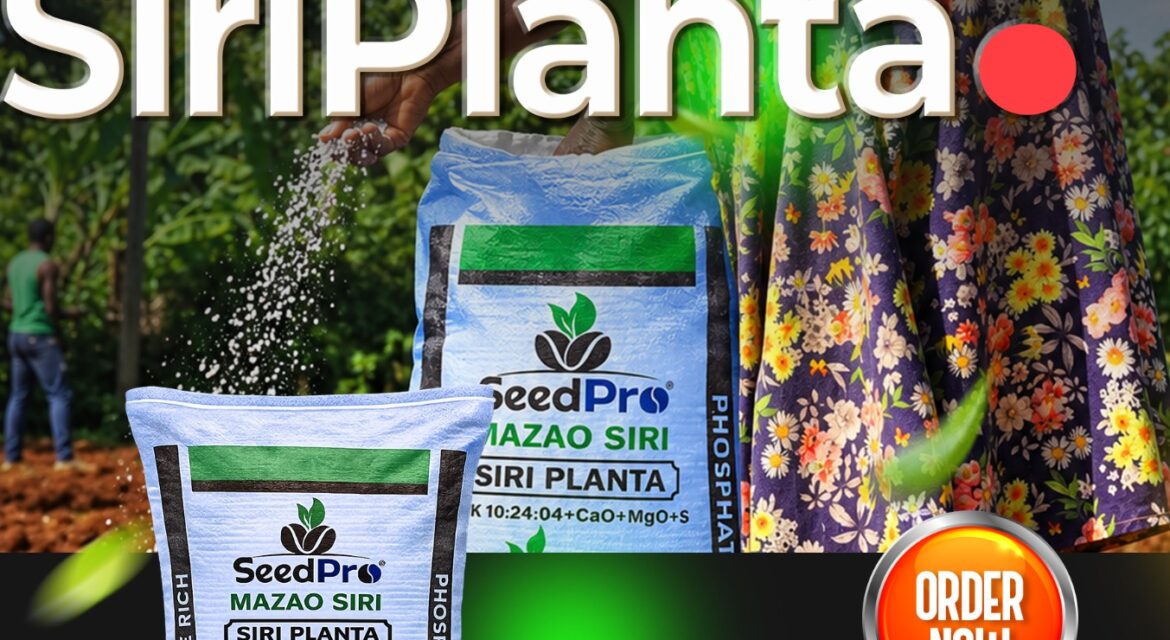
For Kenyan farmers looking for a planting fertilizer, SeedPro Siri Planta NPK 10:24:4 + CaO + MgO + S is one option to consider. It combines nitrogen, phosphorus and potassium with calcium, magnesium and sulphur in an organo-mineral fertilizer formulation.
In this guide, we explain what makes a good maize planting fertilizer, why the nutrients matter, how to use Siri Planta responsibly and what farmers should do after planting to support better crop performance.
1. What Is the Best Fertilizer for Planting Maize in Kenya?
There is no single fertilizer that is automatically the best for every farm in Kenya.
Maize farmers grow their crops in different soil types and climatic conditions. A farm in Western Kenya may have different nutrient requirements from a farm in the Central Highlands or the Eastern region. Even neighbouring farms can respond differently to the same fertilizer because their soil fertility histories may differ.
The best choice depends on several factors:
- Soil fertility: The amount of nitrogen, phosphorus, potassium and other nutrients already available in the soil.
- Soil pH: This affects how readily plants can access certain nutrients.
- Rainfall and moisture: Nutrients must be available in the root zone, and the crop needs sufficient moisture to grow.
- Fertilizer formulation: Different products contain different proportions of nutrients.
- Previous farming practices: Continuous cultivation and previous fertilizer or manure applications can change the soil’s nutrient status.
According to the Kenya Agricultural and Livestock Research Organization (KALRO), maize fertilizer recommendations should account for soil type and agro-ecological conditions. Its guidance discusses different fertilizer options for planting and subsequent top-dressing.
You can read more through the KALRO maize land preparation and soil fertility guide.
The practical lesson is simple: do not choose a fertilizer only because your neighbour uses it. Understand your soil, the crop’s requirements and the role of the fertilizer you intend to apply.
2. Why Is Planting Fertilizer Important for Maize?
Think about maize production as a journey. Planting establishes the starting point, vegetative growth builds the plant, and reproductive growth determines how the crop develops its ears and fills its grain.
A good start does not guarantee a bumper harvest, but poor establishment can make it harder to achieve your yield target.
Planting fertilizer can help supply nutrients when young maize plants begin developing their root systems and leaves.
Supporting early root development
Young maize plants need roots that can explore the soil for water and nutrients. Phosphorus is particularly important for energy transfer and normal root development.
When phosphorus availability is inadequate, young plants may develop slowly. However, phosphorus deficiency is not the only reason for poor early growth. Cold conditions, waterlogging, drought, soil acidity, poor seed quality and other nutrient deficiencies can also affect establishment.
Supporting early vegetative growth
Nitrogen is essential for chlorophyll formation, proteins and vegetative growth. A young maize plant needs nitrogen as it develops leaves and stems.
However, the amount supplied at planting must be considered alongside the crop’s total nitrogen requirement. A planting fertilizer alone may not provide enough nitrogen for the entire growing season.
Supporting balanced nutrition
Maize requires more than nitrogen and phosphorus. Potassium is involved in water regulation and several plant processes, while calcium, magnesium and sulphur perform their own important functions.
The goal is not simply to apply as much fertilizer as possible. It is to provide the nutrients the crop needs without unnecessary expense or excessive application.
3. Introducing SeedPro Siri Planta NPK 10:24:4 + CaO + MgO + S
For farmers searching for a suitable planting fertilizer, SeedPro Siri Planta offers an organo-mineral option designed for planting-stage crop nutrition.
Its formulation is:
Siri Planta NPK 10:24:4 + CaO + MgO + S
Here is what the main nutrient components mean for maize farmers.
Nitrogen (N): Supporting leaf and stem growth
Nitrogen is a major nutrient required for vegetative growth. It contributes to the formation of proteins and chlorophyll, helping maize develop the green leaf area needed for photosynthesis.
Siri Planta contains 10% nitrogen in its stated NPK formulation.
This contributes to early crop nutrition, although additional nitrogen management may be necessary as the maize grows.
Phosphorus (P): Supporting early root establishment
Phosphorus is important for energy transfer, cell function and root development. It is especially relevant during early crop establishment.
Siri Planta contains 24% phosphorus in its stated NPK grade.
Important: Fertilizer grades commonly express phosphorus as phosphorus pentoxide (P₂O₅), rather than elemental phosphorus. Farmers should confirm the guaranteed analysis on the product label when comparing products.
The phosphorus content makes Siri Planta an option to consider for planting nutrition, particularly when its nutrient profile matches the farm’s requirements.
Potassium (K): Supporting water regulation and plant function
Potassium contributes to water regulation, enzyme activation and other processes that support normal crop growth.
Siri Planta contains 4% potassium in its stated NPK formulation. Whether this amount is sufficient for a particular maize field depends on the soil’s potassium supply and the crop’s total requirements.
Farmers should avoid assuming that one fertilizer grade meets every nutrient requirement on every farm.
Calcium oxide (CaO): A source of calcium
Calcium plays a role in cell wall development, cell membrane function and growing plant tissues.
The CaO listed in Siri Planta’s formulation indicates calcium expressed as calcium oxide equivalent. The amount supplied should be confirmed using the product’s guaranteed analysis.
Calcium nutrition is important, but fertilizer containing calcium should not automatically be treated as a substitute for agricultural lime where soil acidity requires correction.
Magnesium oxide (MgO): Supporting photosynthesis
Magnesium is the central atom in chlorophyll, the pigment that allows plants to capture light for photosynthesis.
Adequate magnesium nutrition supports the plant’s ability to produce the energy-rich compounds required for growth.
Sulphur (S): Supporting protein formation
Sulphur is needed for the formation of certain amino acids and proteins. It also participates in important metabolic processes.
Including sulphur in a fertilizer formulation can contribute to crop nutrition where the nutrient is needed.
The actual contribution of calcium, magnesium and sulphur depends on their guaranteed concentrations in the product. Farmers should consult the label for the complete analysis.
4. What Makes Siri Planta Different From Choosing Fertilizer by Habit?
Many farmers have used the same planting fertilizer for years. Familiarity can be useful, especially when a product has performed well under similar conditions.
However, farming conditions change. Soil fertility can decline or improve, rainfall patterns can shift, and crop varieties may differ in their nutrient requirements.
A more informed approach is to evaluate a fertilizer based on its nutrient composition, application rate, cost per acre and performance under the farm’s conditions.
Siri Planta brings together an NPK formulation with calcium, magnesium and sulphur in an organo-mineral product.
Its value should be assessed as part of the complete crop nutrition programme, rather than through its name or formulation alone.
Farmers should also remember that organo-mineral products differ in their organic components and nutrient concentrations. The term organo-mineral does not automatically mean that a fertilizer will increase yield on every soil or eliminate the need for other nutrients.
Good results depend on choosing an appropriate product and using it correctly.
5. How Should Farmers Apply Siri Planta When Planting Maize?
Correct application matters as much as fertilizer selection.
Even a suitable fertilizer can cause problems when it is applied incorrectly, particularly when concentrated fertilizer comes into direct contact with maize seed.
Follow these practical guidelines.
Step 1: Prepare the field properly.
Prepare the land according to your farming system, ensuring that the seedbed and soil moisture are suitable for planting.
Step 2: Determine the appropriate fertilizer rate.
Use the rate recommended on the current Siri Planta label and, where possible, a soil-test-based recommendation. Do not assume that every farm needs the same quantity.
Step 3: Separate the fertilizer from the seed.
Do not place concentrated fertilizer directly against the seed. Position it according to the product instructions, with adequate soil separation to reduce the risk of fertilizer injury.
Step 4: Plant quality maize seed at the recommended spacing and depth.
Use a suitable variety for your area and follow its planting recommendations. Correct plant population is important because overcrowding or poor spacing can reduce the crop’s access to light, moisture and nutrients.
Step 5: Monitor emergence.
Check whether the crop emerges uniformly. Investigate poor germination, weak seedlings or uneven growth rather than automatically assuming that more fertilizer is needed.
For the correct Siri Planta application rate, consult the product label or seek guidance from a SeedPro agronomist. Soil type, planting arrangement and local recommendations should inform the final rate.
6. Is Siri Planta Enough for the Entire Maize Season?
This is an important question.
The short answer is that farmers should not assume a planting fertilizer alone will supply all the nutrients required until harvest.
Maize continues to demand nutrients as it develops leaves, stems, ears and grain. Nitrogen requirements are particularly important during vegetative growth, while the overall nutrient programme should account for the crop’s needs at different stages.
A practical maize nutrition programme should consider three areas.
At planting: Establish the crop
Choose a suitable basal fertilizer based on soil fertility and the product’s nutrient profile. Siri Planta is one option to evaluate at this stage.
During vegetative growth: Review nitrogen requirements
As maize grows, monitor plant development and follow local agronomic recommendations for nitrogen top-dressing. The appropriate product, rate and timing depend on the soil, rainfall, crop stage and fertilizer already applied.
Do not apply additional fertilizer blindly. Account for the nutrients already supplied at planting.
Throughout the season: Manage the whole field
Fertilizer is only one part of maize production. Weed control, adequate moisture, pest and disease monitoring, suitable spacing and timely field operations all contribute to crop performance.
Farmers should also consider soil acidity. Where soil pH limits nutrient availability, adding more fertilizer may not fully address the problem. Soil testing can help determine whether lime or another corrective measure is needed.
KALRO’s maize production guidance provides further information on soil fertility and crop establishment.
7. Can Siri Planta Help Farmers Get Better Maize Yields?
Siri Planta can contribute to a maize nutrition programme when its nutrient composition matches the farm’s needs and it is applied correctly.
However, no fertilizer can guarantee a particular yield.
The final harvest depends on several interacting factors, including rainfall, soil fertility, seed variety, plant population, pest pressure, weed competition and crop management.
A farmer targeting a higher yield should begin by identifying the main constraints on the farm.
For example, if nitrogen is the main limiting nutrient, a phosphorus-focused planting fertilizer by itself will not solve the entire problem. If soil acidity restricts root development and nutrient uptake, the farmer may need to address soil pH. If rainfall is inadequate, fertilizer cannot replace the water the crop needs.
This is why soil testing and agronomic guidance are valuable. They help farmers make decisions based on the actual conditions in their fields.
For farmers considering Siri Planta, the objective should be to use it as part of a well-planned nutrient programme, not as a replacement for sound agronomy.
8. Siri Planta and the Value of Soil-Conscious Farming
Productive maize farming requires attention to both crop nutrition and the condition of the soil.
An organo-mineral fertilizer combines mineral nutrients with an organic component. Depending on its composition and how it is used, the organic component can contribute organic matter to the soil management system.
Nevertheless, the long-term benefits depend on the amount and quality of organic material supplied, the soil’s existing condition and other management practices.
Farmers seeking to maintain soil productivity should consider a broader approach that may include suitable organic amendments, crop rotation, erosion control, appropriate residue management and soil testing.
The goal is to produce a healthy crop today while managing the soil responsibly for future seasons.
That is the thinking behind a more informed approach to fertilizer use: understand what the crop needs, understand what the soil can supply, and apply inputs accordingly.
Frequently Asked Questions About Siri Planta and Maize Fertilizer
What is the best fertilizer for planting maize in Kenya?
There is no single best fertilizer for every Kenyan farm. DAP and various NPK formulations are used as planting fertilizers, but the appropriate choice depends on soil fertility, soil pH, crop requirements and the overall fertilizer programme. Siri Planta NPK 10:24:4 + CaO + MgO + S is one option farmers can consider where its nutrient profile is suitable.
Is Siri Planta good for planting maize?
Siri Planta is a planting fertilizer formulated with nitrogen, phosphorus, potassium, calcium, magnesium and sulphur. It can form part of a maize nutrition programme when its composition and application rate match the farm’s requirements. Follow the current product label and local agronomic recommendations.
What does NPK 10:24:4 mean?
The numbers describe the stated proportions of nitrogen, phosphorus expressed as P₂O₅, and potassium expressed as K₂O in the fertilizer grade. Siri Planta also lists CaO, MgO and S in its formulation.
Should I apply Siri Planta directly into the maize planting hole?
Do not allow concentrated fertilizer to come into direct contact with maize seed. Follow the product label for placement and application rate, ensuring adequate soil separation.
Can I use Siri Planta and DAP together when planting maize?
Do not automatically combine the two fertilizers. Both supply nutrients, and using them together without calculating the total nutrient application may lead to unnecessary expense or excessive nutrient rates. A soil test and agronomic recommendation can help determine whether combining them is justified.
Do I still need to top-dress maize after using Siri Planta?
Possibly. The need for top-dressing depends on the crop’s total nutrient requirements, the amount supplied at planting, soil fertility and expected yield. Many maize production programmes include additional nitrogen during vegetative growth. Follow a recommendation suited to your farm.
Can Siri Planta guarantee bigger maize cobs?
No fertilizer can guarantee bigger cobs. Cob development depends on the variety, plant population, soil fertility, moisture, crop health and management throughout the season. Appropriate planting nutrition helps address nutrient needs but cannot overcome every production constraint.
Where can I get Siri Planta in Kenya?
Farmers interested in Siri Planta can contact SeedPro for product information, current availability and guidance on the appropriate fertilizer programme for their crop.
Conclusion: Start Your Maize Crop With a Plan
A good maize harvest does not begin when the crop develops ears. It begins much earlier, with the decisions a farmer makes before and during planting.
Choosing the right planting fertilizer, protecting the seed, establishing the correct plant population and planning for subsequent nutrient requirements all matter.
For farmers searching for the best fertilizer for planting maize in Kenya, SeedPro Siri Planta NPK 10:24:4 + CaO + MgO + S is an option worth considering as part of an appropriate crop nutrition programme.
Its combination of NPK nutrients, calcium, magnesium and sulphur provides a broader nutrient profile than a fertilizer containing only one or two primary nutrients. Whether it is the best choice for your farm depends on the soil’s nutrient status and the crop’s requirements.
Before planting, ask yourself three questions:
- What nutrients does my soil lack?
- What fertilizer supplies the nutrients my maize needs?
- How will I manage nutrition after planting?
Answering these questions can help you make better input decisions, reduce guesswork and work towards a more productive maize season.
SeedPro: Ni Siri Ya Mazao.
For guidance on Siri Planta and other SeedPro crop nutrition products, contact SeedPro Africa or speak with an agronomist about your soil, maize variety and planting plan.