 06 June 2026
Complete Potato Nutrition Program for Higher Potato Yields in Kenya
Potato farming remains one of the most profitable agricultural enterprises in Kenya. From Nyandarua and Nakuru to Elgeyo Marakwet, Bomet, Narok, Meru, and parts of Central Kenya, thousands of farmers depend on potatoes for income and food security.
Yet many farmers continue to face one major challenge: achieving consistently high yields and quality tubers.
Poor nutrition is among the leading causes of low potato yields. Many farmers focus only on basal fertilizers and overlook the importance of providing nutrients throughout the crop’s growth cycle. As a result, potatoes may develop weak roots, poor tuber formation, uneven sizing, and increased susceptibility to diseases.
The secret behind high-yield potato farming is not a single fertilizer. It is a complete nutrition program that supports the crop from planting to harvest.
Why Potato Nutrition Matters
Potatoes are heavy feeders. They require a balanced supply of macro and micronutrients throughout their growth stages.
Proper nutrition helps:
- Develop strong root systems
- Improve nutrient uptake
- Encourage vigorous vegetative growth
- Increase tuber initiation
- Enhance tuber bulking
- Improve skin quality
- Increase disease tolerance
- Produce larger and more uniform potatoes
- Increase marketable yields
When nutrition is inadequate at any stage, the crop’s potential yield can be significantly reduced.
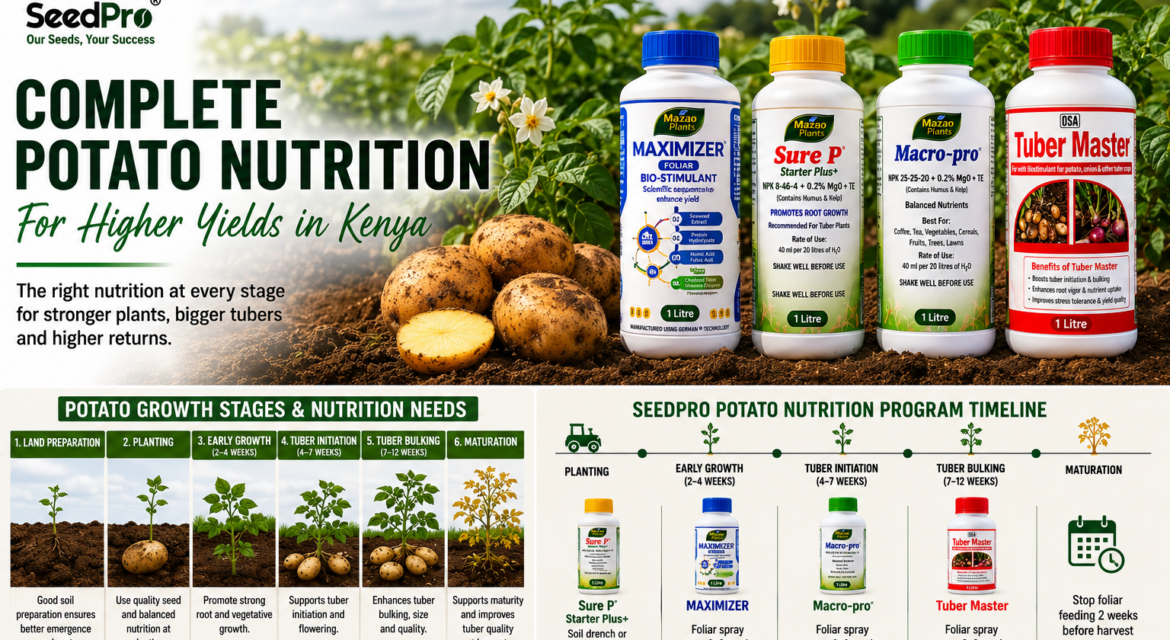
Understanding Potato Growth Stages
Successful potato production begins with understanding the nutritional needs of the crop at each growth stage.
1. Planting and Germination Stage
This is where the foundation of the entire crop is established.
At this stage, potatoes need:
- Strong root development
- Rapid emergence
- Healthy sprouting
- Better establishment
A crop that emerges uniformly often produces more consistent yields compared to one with uneven establishment.
Poor establishment can lead to reduced plant populations and lower yields at harvest.
2. Early Vegetative Growth
Once the crop emerges, the plant focuses on developing leaves, stems, and roots.
The objectives during this stage are:
- Strong canopy development
- Enhanced photosynthesis
- Increased nutrient absorption
- Improved plant vigor
Healthy vegetative growth prepares the crop for successful tuber initiation later in the season.
3. Tuber Initiation Stage
This is one of the most critical stages in potato production.
During tuber initiation, the plant begins forming new tubers underground.
The number of tubers initiated often determines the final yield potential.
Poor nutrition during this stage may result in:
- Fewer tubers
- Small tubers
- Reduced marketable yield
4. Tuber Bulking Stage
At this stage, the plant directs energy toward enlarging the tubers.
This period has the greatest impact on yield and profitability.
Proper nutrition during bulking promotes:
- Larger tubers
- Better tuber weight
- Improved quality
- Higher marketable yields
The Complete Potato Nutrition Program
A comprehensive nutrition strategy ensures that potatoes receive the nutrients they require at every stage of development.
Maximizer Bio-Stimulant
Maximizer Bio-Stimulant plays a key role during germination and early growth.
Benefits include:
- Enhanced root development
- Improved nutrient uptake
- Increased plant vigor
- Better stress tolerance
- Faster establishment
Bio-stimulants help plants maximize the efficiency of available nutrients while promoting healthy growth.
For farmers aiming to improve emergence and root development, this stage is extremely important.
Sure P Starter Plus+
Early nutrition significantly influences future performance.
Sure P Starter Plus+ supports:
- Root initiation
- Root expansion
- Strong plant establishment
- Enhanced nutrient absorption
A strong root system enables potatoes to access water and nutrients more effectively throughout the growing season.
Farmers who invest in root development often experience healthier crops and better yields.
Macro-Pro Balanced Nutrition
Vegetative growth determines the crop’s ability to produce energy through photosynthesis.
Macro-Pro supports:
- Balanced nutrient supply
- Healthy leaf development
- Increased photosynthetic activity
- Strong vegetative growth
A healthy canopy captures more sunlight, enabling the crop to produce more carbohydrates needed for tuber development.
Balanced nutrition during this phase lays the groundwork for higher yields later.
Tuber Master
Tuber Master is designed specifically for tuber crops.
Its role includes:
- Supporting tuber initiation
- Enhancing tuber bulking
- Improving nutrient uptake
- Increasing tuber size
- Enhancing overall quality
For potato farmers focused on maximizing profits, tuber development products can make a significant difference.
Benefits of a Complete Potato Nutrition Program
Farmers who implement a structured nutrition program often report improvements in:
Stronger Root Development
Healthy roots are the engine of nutrient and water uptake.
Stronger roots support:
- Better drought tolerance
- Improved nutrient absorption
- Enhanced plant stability
More Tubers Per Plant
Proper nutrition encourages successful tuber initiation.
More tubers per plant generally translate into higher yield potential.
Uniform Tuber Size
Uniform potatoes are preferred by traders, processors, supermarkets, and consumers.
Consistency improves marketability and reduces grading losses.
Better Skin Quality
Quality potatoes command higher prices.
Good nutrition contributes to:
- Improved appearance
- Better shelf life
- Reduced damage during handling
Improved Disease Tolerance
Well-nourished crops are often more resilient to environmental stress and disease pressure.
Balanced nutrition strengthens overall plant health.
Higher Marketable Yield
Ultimately, farmers are interested in the quantity and quality of potatoes they can sell.
A complete nutrition program helps maximize both.
Common Potato Nutrition Mistakes Farmers Should Avoid
Relying Only on Basal Fertilizer
Many farmers apply fertilizer during planting and assume the crop has everything it needs.
Potatoes require continuous nutrition throughout the season.
Ignoring Micronutrients
Micronutrients are required in small amounts but play crucial roles in plant growth and development.
Deficiencies can significantly affect yields.
Poor Timing of Foliar Applications
Applying foliar feeds at the wrong stage reduces their effectiveness.
Nutritional interventions should align with crop growth stages.
Overlooking Root Development
Many farmers focus only on foliage while neglecting roots.
Without strong roots, nutrient uptake becomes limited.
How Nutrition Impacts Potato Profitability
Profitability is not determined by yield alone.
Farmers must also consider:
- Marketable tubers
- Uniform sizing
- Disease-free produce
- Storage performance
- Consumer preference
A nutrition program that improves these factors often delivers better financial returns.
For example:
A farmer harvesting 12 tonnes per acre may earn less than one harvesting 10 tonnes if a large percentage of the crop is undersized or unmarketable.
Quality matters.
Potato Farming in Kenya: Future Opportunities
Demand for potatoes continues to rise across Kenya.
Growth in:
- Urban populations
- Fast food outlets
- Hotels
- Restaurants
- Processing industries
is creating increasing demand for quality potatoes.
Farmers who adopt modern nutrition programs are better positioned to meet this demand and maximize profits.
As production costs rise, efficiency becomes increasingly important.
Providing the right nutrients at the right stage can significantly improve productivity and profitability.
Final Thoughts
Successful potato farming is built on proper nutrition.
A complete potato nutrition program supports the crop from planting to harvest, helping farmers achieve stronger roots, more tubers, better quality, improved disease tolerance, and higher yields.
Instead of focusing on a single fertilizer application, successful potato growers understand the importance of supplying balanced nutrition throughout the crop cycle.
By investing in proper crop nutrition, farmers can unlock the full potential of their potato fields and achieve better returns season after season.
Frequently Asked Questions
What is the best fertilizer for potatoes in Kenya?
The best approach is a complete nutrition program that supports potatoes from planting through tuber bulking rather than relying on a single fertilizer.
How can I increase potato yields?
Focus on balanced nutrition, proper spacing, quality seed, pest and disease management, and timely foliar feeding.
Why are my potatoes producing small tubers?
Small tubers can result from poor nutrition, inadequate moisture, poor seed quality, or insufficient nutrient availability during tuber initiation and bulking.
How important is foliar feeding in potatoes?
Foliar feeding helps supply nutrients quickly during critical growth stages and complements soil-applied fertilizers.
What determines potato quality?
Nutrition, variety selection, disease management, irrigation, and harvesting practices all influence potato quality and marketability.