 24 September 2026
Onion Farming Guide in Kenya: Complete Guide from Planting to Harvest
Introduction: Onion Farming in Kenya
If you are searching for an onion farming guide in Kenya, you are probably looking for more than just information on planting onions.
You want to know which varieties to grow, how to prepare the nursery, when to transplant, the correct onion spacing, how often to irrigate, which fertilizer to use, how to increase bulb size, how to prevent diseases and, eventually, when to harvest.
Onion farming in Kenya can be rewarding when the crop is properly managed, but onions are also sensitive to poor nutrition, inconsistent moisture, overcrowding, poor drainage and disease pressure.
A successful onion crop therefore starts long before the bulbs begin forming.
This complete onion farming guide takes you through the crop from nursery to harvest, while also explaining how balanced nutrition can support onion development at different stages.
If you are looking for more detailed information specifically on onion nutrition, SeedPro has also published Onions Require Which Nutrients? A Practical Feeding Guide for High Yields.
1. Choose the Right Onion Variety
The first decision in onion farming is choosing planting material that suits your production environment and target market.
Farmers should consider:
- The local climate
- Day length requirements
- Disease tolerance
- Maturity period
- Bulb size
- Bulb colour and shape
- Storage characteristics
- Market demand
Do not choose a variety simply because another farmer harvested large onions from it.
The performance of a variety can change depending on location, soil, temperature, water availability and crop management.
Your target market should also influence your choice.
If buyers in your area prefer particular bulb sizes, colours or shapes, those preferences should be considered before planting.
2. Start With a Healthy Onion Nursery
Good onion farming begins with good seedlings.
A weak seedling can struggle throughout the season, while healthy seedlings establish more quickly after transplanting.
Prepare a nursery in a well drained area with fertile soil. Avoid sites that have recently carried crops with serious soil borne disease problems.
The nursery should receive adequate moisture without becoming waterlogged.
Seeds should be planted at an appropriate depth and the nursery protected from excessive rain, pests and disease.
The objective is to produce seedlings with a strong root system and healthy foliage before transplanting.
3. Prepare the Land Properly
Onions have a relatively shallow root system, so the condition of the upper soil layer matters greatly.
Prepare the land to create a fine, well structured seedbed while ensuring good drainage.
Onions generally perform well in fertile, well drained soils. KALRO guidance places the suitable soil pH for onions around 6.0 to 6.8.
A soil test is highly recommended before planting because it can help identify nutrient deficiencies and soil constraints before money is spent on fertilizer.
Do not wait until the onions are already struggling to discover that the soil has a fertility problem.
4. Onion Spacing in Kenya
Spacing affects the number of plants in a given area, competition between plants and ultimately the size and uniformity of bulbs.
Very close spacing can increase competition for light, water and nutrients and may result in smaller bulbs.
Wider spacing can give individual plants more room, although the ideal spacing depends on the variety, target bulb size and production system.
Farmers should therefore follow the recommended spacing for their selected variety instead of copying another farmer’s spacing blindly.
Good spacing also improves air movement around the crop, which can help with crop management and disease prevention.
5. Onion Fertilizer: Start With Balanced Nutrition
One of the most common questions in onion farming is:
What is the best fertilizer for onions in Kenya?
There is no single fertilizer that is automatically the best for every onion field.
The right programme depends on the soil, variety, crop stage and existing nutrient levels.
This is where balanced nutrition becomes important.
DAP Plus at Planting
SeedPro DAP Plus can form part of the basal nutrition programme at planting or establishment.
Its organo-mineral formulation provides NPK together with calcium and magnesium.
Phosphorus is particularly important during early root development and establishment, giving the young crop a stronger foundation as it develops.
But remember:
More fertilizer does not automatically mean bigger onions.
The crop needs the right nutrient, at the right rate, at the right time.
6. Sure P for Early Root Development
Phosphorus plays an important role in root development and energy transfer within plants.
Where additional phosphorus is required, SeedPro Sure P can be incorporated into the onion nutrition programme according to the crop’s needs and recommended application rates.
The objective is to maintain a healthy root system capable of taking up water and nutrients efficiently.
This is particularly important because onion bulb development later in the season depends on the crop having a strong foundation.
7. Nitrogen: Important, But Do Not Overdo It
Nitrogen supports leaf development and chlorophyll production.
For onions, healthy leaves are extremely important because they are the plant’s photosynthetic factory.
The leaves capture sunlight and manufacture carbohydrates that contribute to crop development and bulb formation.
However, excessive nitrogen can create problems.
Too much nitrogen, particularly at the wrong stage, can encourage excessive vegetative growth, delay maturity and contribute to thick necks.
This is why onion farmers should avoid the mentality of:
“The more nitrogen I apply, the bigger my onions will become.”
Good onion nutrition is about balance.
8. Sure N: Build the Onion Leaf Factory
During the vegetative stage, SeedPro Sure N High Nitrogen can be used when the crop requires additional nitrogen to support leaf development.
The aim is to establish a healthy canopy before the crop moves strongly into bulb development.
Think of the process like this:
Healthy leaves → photosynthesis → carbohydrate production → movement of energy into the developing bulb.
This is why building healthy foliage early matters.
However, once the crop moves towards bulb formation, the farmer should reassess the nutrition programme rather than continuing with high nitrogen applications indefinitely.
9. Irrigation: Give Onions Consistent Moisture
Water management is one of the most important parts of onion farming in Kenya.
Onions require adequate moisture during active growth and bulb development.
But there is a major difference between adequate moisture and waterlogging.
Too little water can cause stress and interfere with growth and bulb development.
Too much water can create poorly aerated soil conditions and increase the risk of root and bulb problems.
Drip irrigation can be particularly useful because it allows farmers to deliver water closer to the root zone.
As the crop approaches maturity, irrigation should be managed carefully rather than simply continuing with heavy watering.
For more information, farmers can also read SeedPro’s Complete Onion Farming Guide in Kenya.
10. How to Increase Onion Bulb Size
Every onion farmer wants large, marketable bulbs.
But bulb size is the result of several factors working together.
To support good bulb development:
- Start with quality planting material.
- Maintain appropriate spacing.
- Establish a strong root system.
- Build healthy foliage early.
- Maintain adequate moisture.
- Avoid severe water stress.
- Correct nutrient deficiencies.
- Avoid excessive nitrogen.
- Maintain good weed control.
- Manage pests and diseases.
- Provide balanced nutrition during bulb development.
SeedPro’s Onion Farming Guide for Maximum Bulb Size goes deeper into the factors that influence onion bulb development.
Remember, a large bulb is not created by one fertilizer application.
It is built over the entire crop cycle.
11. Macro Pro During Crop Development
As the crop moves through active development, farmers may use foliar nutrition to supplement the crop where appropriate.
SeedPro Macro Pro provides NPK, magnesium, trace elements and plant growth regulators and can be incorporated into a crop nutrition programme according to crop requirements.
For onions, the goal is to support the plant when it needs additional nutritional support rather than using foliar fertilizer as a replacement for proper soil fertility.
Foliar nutrition works best when it forms part of a wider crop management programme.
12. Tubermaster for Onion Bulb Development
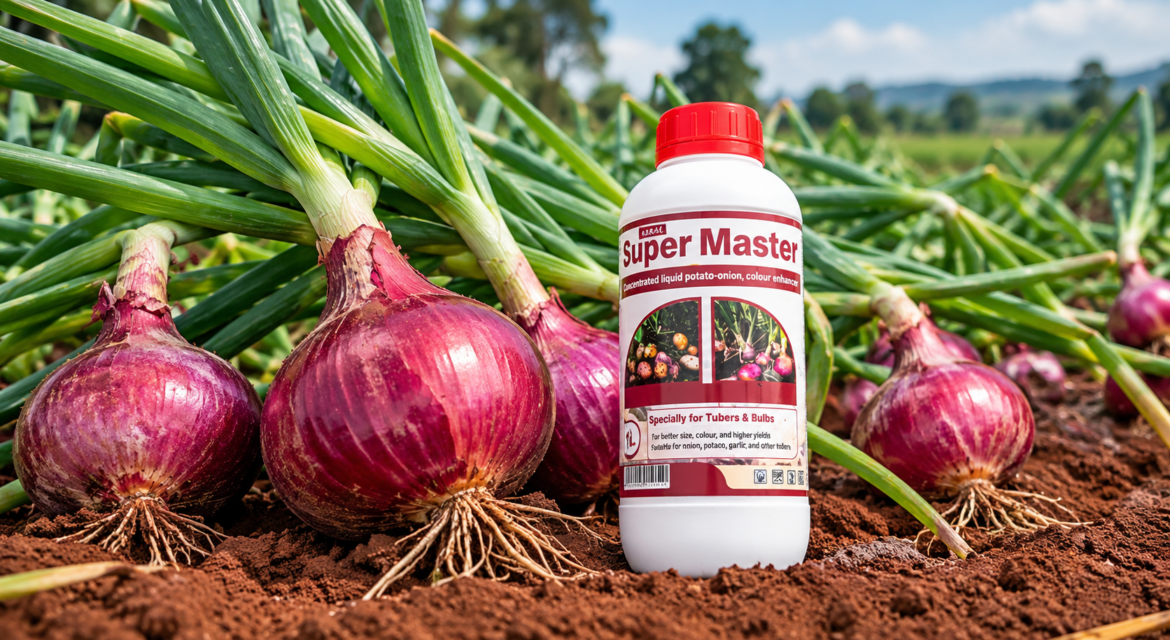
The name may suggest potatoes, but SeedPro Tubermaster can also be incorporated into nutrition programmes for onions.
Onions develop a bulb underground, making proper root and bulb development extremely important.
Tubermaster contains components including humic and fulvic substances and nutrients designed to support crop development and nutrient utilization.
It can therefore form part of the nutrition programme during the stages when the farmer is focusing on bulb development.
Farmers should always follow the recommended product rate and application timing.
For more information, see SeedPro’s article on the best foliar fertilizer for potatoes and onions in Kenya.
13. Sure K and Onion Bulb Filling
Potassium is an important nutrient in crop water regulation, enzyme activity and the movement of photosynthetic products.
As onions move towards bulb filling and quality development, potassium nutrition becomes particularly important.
SeedPro Sure K High Potassium can be incorporated into an onion nutrition programme where additional potassium is required.
The objective is to support proper crop development rather than simply applying potassium because the crop is producing bulbs.
As always, application should follow the recommended rate and crop timing.
14. How to Prevent Onion Bulb Rot
Bulb rot is one of the problems that can quickly turn a promising onion crop into a disappointing harvest.
Prevention should begin before the bulbs start rotting.
Farmers should:
- Use healthy planting material.
- Avoid planting in poorly drained soils.
- Maintain appropriate spacing.
- Avoid excessive irrigation.
- Avoid unnecessary injury to bulbs.
- Maintain good field hygiene.
- Remove severely diseased plants or bulbs where appropriate.
- Avoid excessive nitrogen, particularly late in the crop.
- Harvest at the correct maturity.
- Cure onions properly before storage.
The Kenya Ministry of Agriculture onion disease management manual provides additional guidance on onion diseases, nutrition, spacing, curing and crop management.
The important lesson is that bulb rot is easier to prevent than to manage after it has spread through the crop.
15. Onion Pests and Diseases
Common onion production problems can include thrips, fungal diseases, bacterial problems and other pests and diseases depending on the production area and conditions.
Regular scouting is therefore important.
Do not wait until the entire field changes colour before inspecting the crop.
Walk through the field regularly and check:
- Leaves
- Growing points
- Bulbs
- Roots
- Soil moisture
- Signs of insects
- Leaf spots
- Wilting
- Discolouration
- Rotting tissue
Early detection gives the farmer more time to identify the actual problem and take appropriate action.
Avoid applying pesticides simply because the crop “doesn’t look right.”
First identify the problem.
16. Weed Management in Onion Farming
Onions are relatively poor competitors against weeds, particularly during early growth.
Weeds compete with the crop for water, nutrients, light and space.
Good weed management therefore helps the onion crop make better use of available resources.
Farmers should control weeds early and avoid damaging the shallow onion root system during cultivation.
Mulching can also be considered depending on the production system, availability of materials and disease risk.
17. When Should Onions Be Harvested?
Harvesting at the correct maturity is important for both market quality and storage.
As onions mature, the leaves begin to yellow and fall over.
KALRO guidance indicates that bulb onions are ready for harvesting when around 75% of the tops have fallen over and dried, with the neck becoming dry and tight.
Do not harvest immature bulbs simply because the market price looks attractive.
Likewise, do not leave mature bulbs in the field unnecessarily.
The correct harvesting stage contributes to better curing and storage.
18. Onion Curing and Storage
Growing the onions is only half the job.
What happens after harvest can determine how much of your production remains marketable.
Proper curing allows the outer layers and neck to dry and form a protective barrier around the bulb.
Cure onions in a dry, well ventilated environment protected from rain and excessive direct sunlight.
Only store healthy, properly cured bulbs.
Remove damaged, diseased or poorly cured bulbs because they can become sources of problems during storage.
The Kenya Ministry of Agriculture also provides guidance on proper onion curing and post harvest handling.
19. A Practical SeedPro Onion Nutrition Programme
A SeedPro onion nutrition programme should be based on crop stage rather than applying every product at once.
Planting and Establishment
DAP Plus
Use as part of the basal nutrition programme to support establishment and early root development.
Early Root Development
Sure P
Use where additional phosphorus support is appropriate according to soil and crop requirements.
Vegetative Development
Sure N
Use when the crop requires additional nitrogen to support healthy foliage.
Crop Development
Macro Pro
Use as supplementary foliar nutrition where appropriate.
Bulb Development
Tubermaster
Incorporate into the programme where appropriate to support underground crop development.
Bulb Filling and Quality
Sure K
Use where additional potassium nutrition is required during the appropriate crop stage.
The exact rate and timing should always follow SeedPro’s product recommendations and should be adjusted according to soil fertility, variety, irrigation system and crop condition.
20. Common Onion Farming Mistakes to Avoid
Some onion farmers lose potential yield not because they lack fertilizer, but because of simple management mistakes.
Avoid:
Planting without considering the variety and market.
Overcrowding the crop.
Overwatering.
Allowing the crop to suffer prolonged water stress.
Applying excessive nitrogen late in the season.
Ignoring early signs of pests and disease.
Growing onions in poorly drained soil.
Harvesting too early.
Poor curing after harvest.
Using fertilizer without considering the soil and crop stage.
Good onion farming is about managing many small decisions correctly.
Conclusion: The Complete Onion Farming Guide in Kenya
Onion farming in Kenya can be rewarding, but successful production requires more than planting seedlings and waiting for bulbs.
You need to start with good planting material, prepare the soil properly, maintain the right spacing, manage irrigation carefully and provide balanced nutrition throughout the crop cycle.
The nutrition strategy should also change as the onion plant develops.
DAP Plus and Sure P can support establishment and root development.
Sure N can support vegetative growth when nitrogen is required.
Macro Pro can provide supplementary foliar nutrition during crop development.
Tubermaster can form part of the programme during underground bulb development.
And Sure K can support potassium nutrition during bulb filling and quality development.
But fertilizer is only one part of the equation.
Good soil + healthy roots + productive leaves + balanced nutrition + proper water management + disease prevention + correct harvesting and curing = a stronger onion production system.
So the next time you ask:
“How can I grow bigger onions?”
Don’t start with the fertilizer bag.
Start with the crop.
Understand what the onion needs at each stage, then provide those requirements at the right time.
That is how you move from simply growing onions to becoming a better onion farmer.
For more onion production information, explore SeedPro’s Complete Onion Farming Guide, Onion Nutrition Guide and Onion Bulb Size Guide.
SeedPro: Ni Siri Ya Mazao.